
Constantine Andreou made sculpture, paintings, and coloured reliefs in which birds, eyes, and human figures appear in many guises. The works selected here range from the upright brass silhouette of Oiseau vers le ciel to the reclining forms of Femme vague.
Andreou (1917–2007) was a sculptor, painter, and printmaker whose life connected Brazil, Greece, and France. In his writing, he described drawing as a way to turn a sensation into an imagined image, and metal as a way to carry a line into space. His words on sculpture and painting, together with the observations of his critics, accompany the works below.
One imagination, many materials
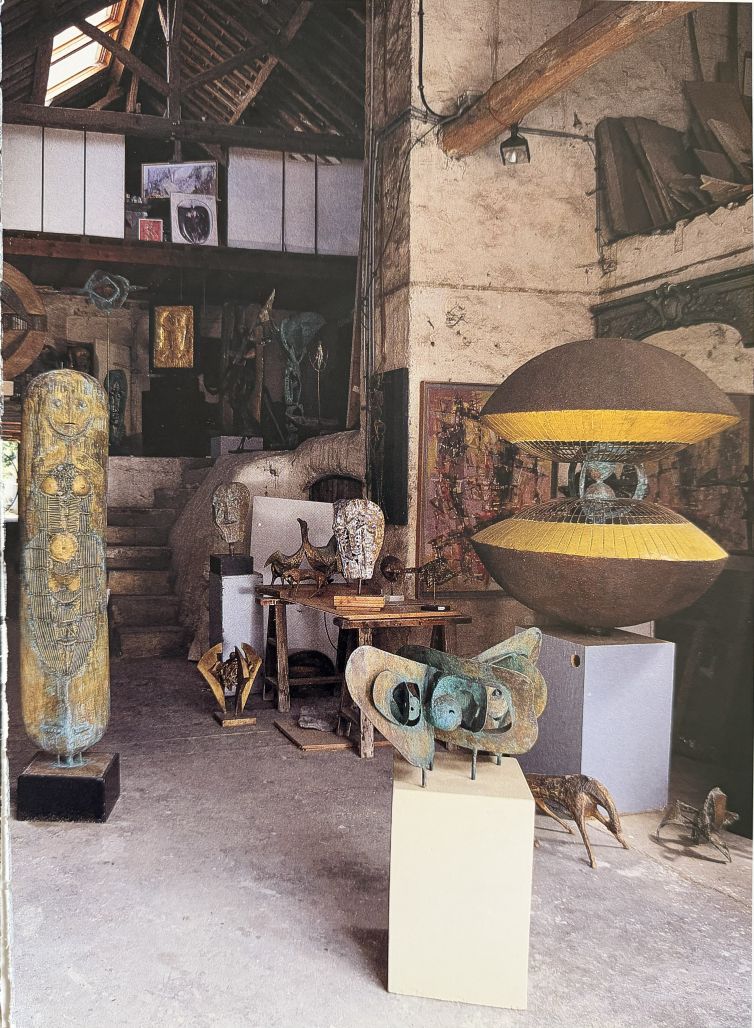
Francis Villadier described a studio with spaces for painting, printmaking, sculpture, coloured relief, and modelling. He saw a common imagination at work across these activities, even as Andreou adapted his approach to each material. A curve, an opening, or a repeated mark may return in a different form in another medium.1
Drawing into space
Sculpture is a way of expressing our poetry through forms in different materials.
Constantine Andreou, artist’s statement in Andreou: Sculpture (Bastas Editions, 1999), p. 237. Translated from the French.
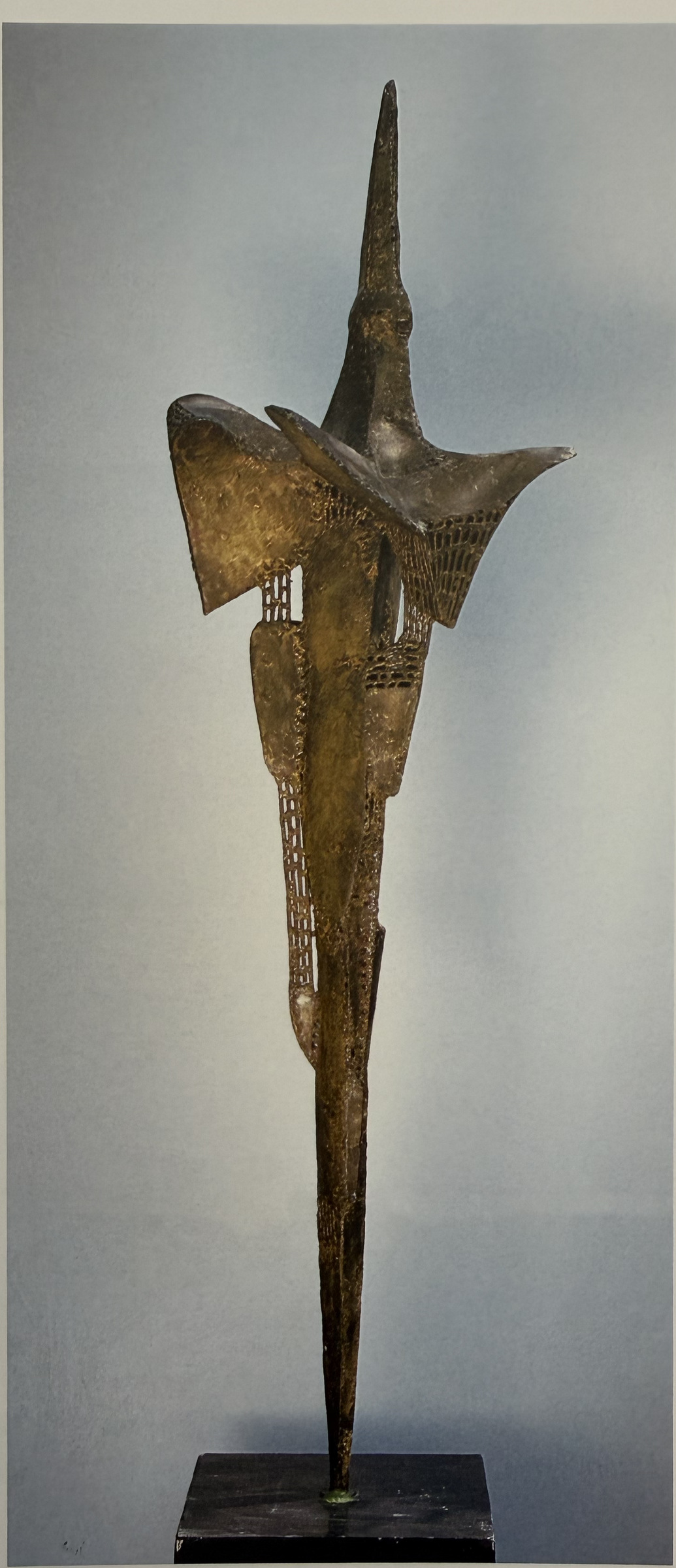
Oiseau vers le ciel is narrow and upright, with wing-like planes spreading from its body. Small grids punctuate the brass, and the background is visible through its openings. These gaps make the tall metal form appear lighter.
Read more about Andreou’s birds and imagined flight in Birds and the dream of flight.
Andreou described using brass wire to draw a sculpture’s inner and outer forms.2 Drawing in space: Andreou’s sculpture examines how plates and rods give shape to Flamenco, Germination, and an open column.
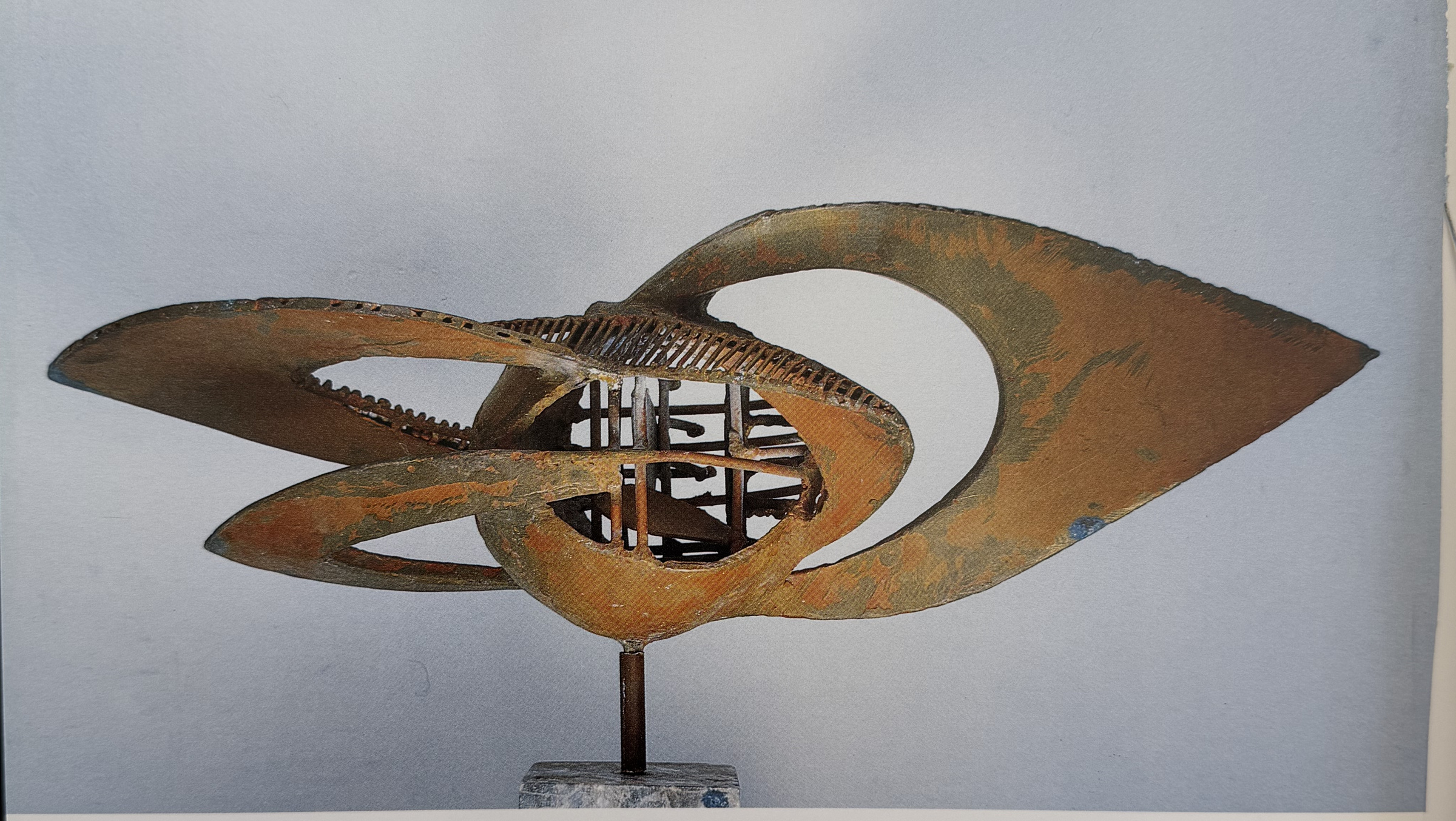
In Oeil Radar, pointed plates surround an exposed framework. We can look into the eye as well as recognise its shape. Villadier suggested that Andreou’s open eyes might express his curiosity.1 Eyes and inner worlds places this sculpture alongside three other eyes, whose layered surfaces and fine rods enclose very different centres.
In The tragic human figure, two heads titled Homme détruit show how openings and jagged edges can suggest suffering. The essay also considers figures confined within the lines of a painting.
Where sculpture meets colour
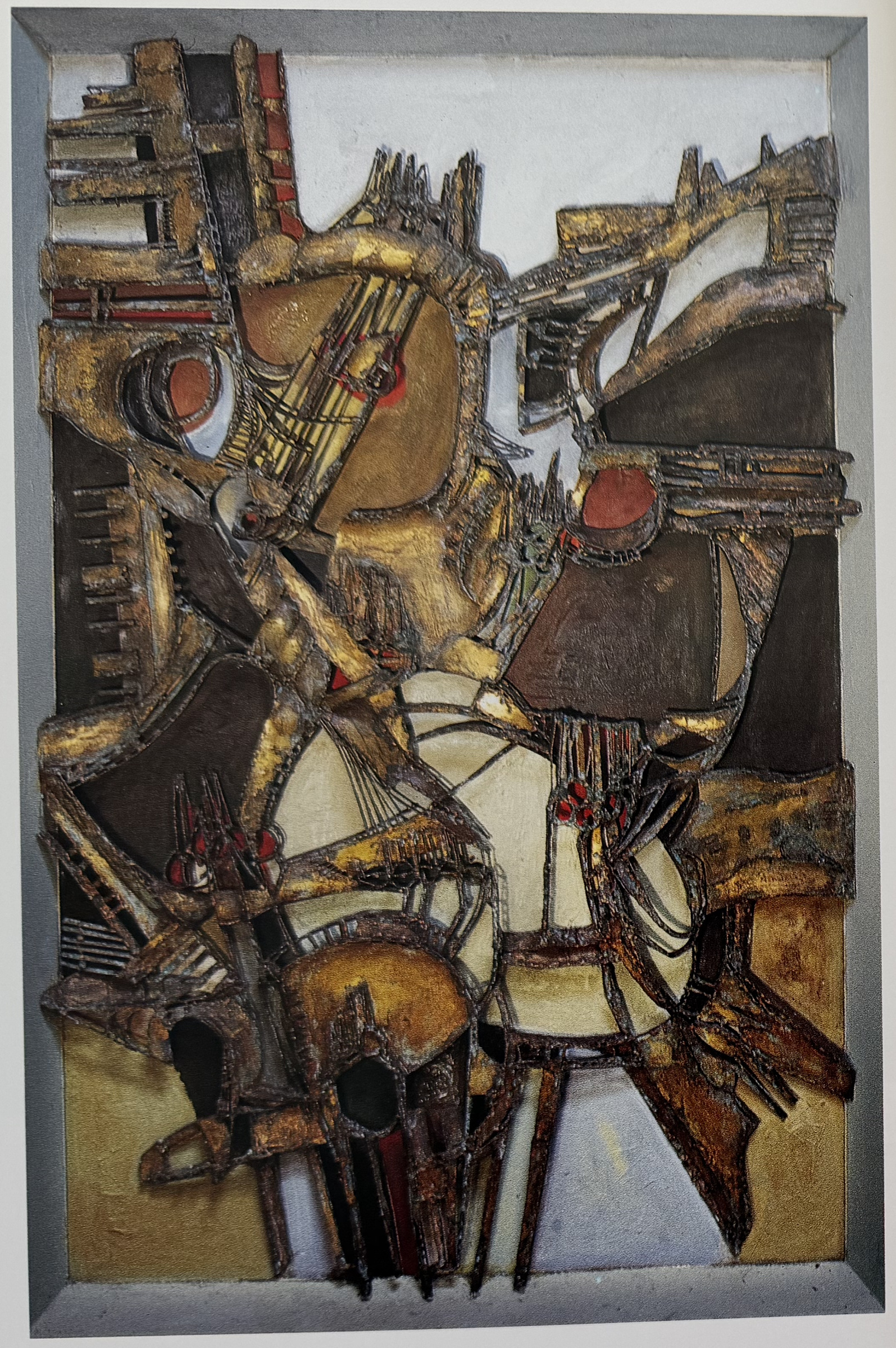
In Symphonie d’oiseau, brass curves, angular pieces, and wire grids overlap within a rectangular frame. Small red accents break up the darker metal. Projecting edges cast shadows that add further lines to the surface.
Villadier described the reliefs as a meeting of form and colour.1 In Where sculpture meets colour, Symphonie d’oiseau appears alongside three further reliefs. Their coloured recesses, projecting plates, and cast shadows show how colour and depth work together.
Heat and movement
Foundries and moving landscapes explores fire, smoke, and the sensation of travelling through a landscape in Andreou’s painting. Two works from 1961 show colour crossed by dense, intersecting marks.
Painting through the mirror
Thus, my painting seeks harmony: a symphony of graphic marks, drawing, colour and light.
Constantine Andreou, signed artist’s statement in Femme · Femmes: Peintures (Édition G. Giannoussis, 1997). Translated from the French.
In his introduction to Femme · Femmes, Andreou begins with the sketch: the first marks through which something felt or observed can become something imagined. He describes a practice sustained by work, repeated questioning, and the search for harmony between drawing, colour, and light.3
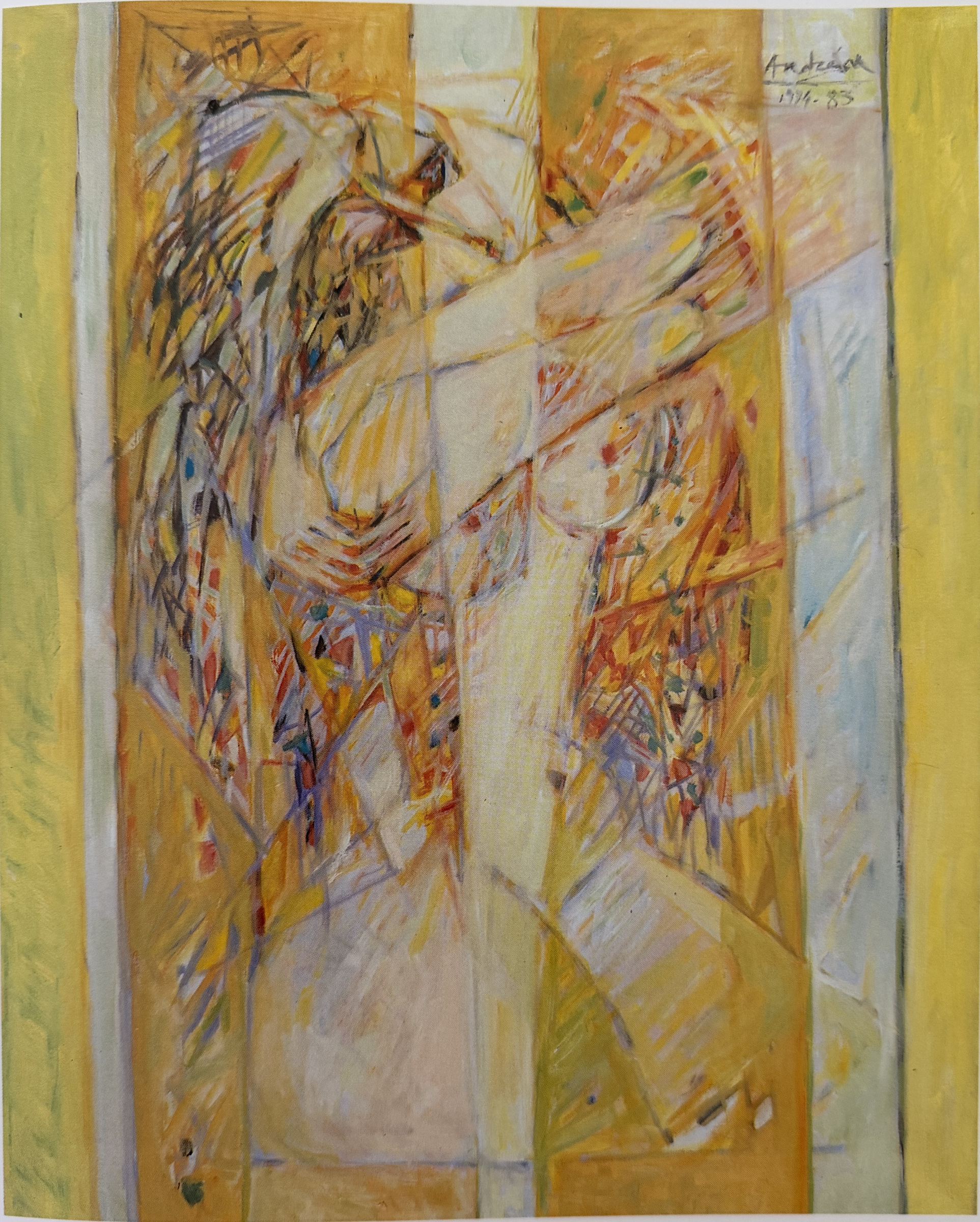
In Miroir jaune, short strokes cross the figure and the space around her. Pale passages break through the yellow field; contours overlap and sometimes fade from view. Sophia Kazazi’s essay on the mirror paintings examines how the woman, her reflection, and her surroundings interact.4 The comparisons in Women and mirrors take up this question across five paintings, including this one.
A window changes the terms of the encounter. The women in The windows of Amsterdam are seen by someone looking in from outside. Painted divisions cut across their bodies and the spaces around them. Kazazi’s essay asks how the spectator’s gaze affects the figure’s appearance.
Figures together
Where two profiles meet, one drawn line can belong to both faces. The kiss and the couple looks closely at that contact, and at the enclosing curves and dense marks around it. Kazazi’s reading allows tenderness and unease to coexist.
Several heads can be held together just as closely. In The family in Andreou’s painting, repeated strokes and patches of colour connect figures at different heights. The faces are recognisable, but the bodies often merge into the surrounding planes. Looking for each person draws attention to the composition as a whole.
When the figure becomes a wave
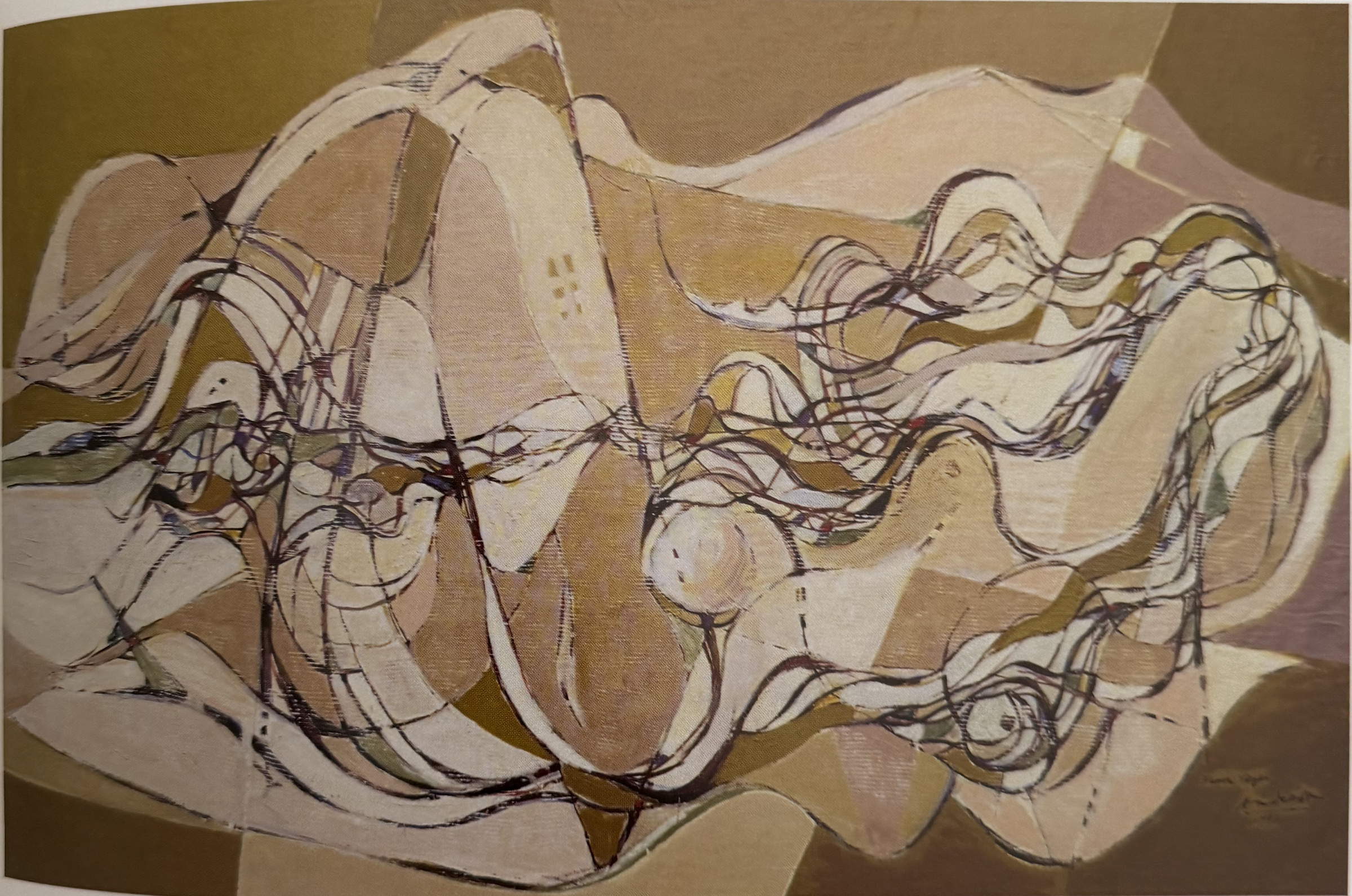
The distinction between body and setting becomes still more fluid in Femme vague. Reclining forms extend across an ochre field. The lines that describe a shoulder or a hip continue into larger loops, making it difficult to decide where one body ends and another movement begins.
In her discussion of the Amour des vagues theme, Kazazi connected curves and spirals with Andreou’s earlier sculptures of sirens and waves. She saw women and the sea transforming one another in these paintings.5 Amour des vagues: women and the sea considers three versions of that exchange, where a figure can be both a reclining body and part of the water’s movement.
André Perrot cautioned against dividing Andreou’s paintings too rigidly into themes. In his account, colour, light, and the continual remaking of the female figure connect these subjects.6
In an undated French typescript, Andreou describes the twentieth century as a time of creative freedom for artists. He also writes that time is the best judge of his work.7
Keep looking
The catalogue provides images and records for individual works. For museums, public collections, and visiting information, see Where to see Constantine Andreou’s art. For more about Andreou’s life and the writing on his art, continue with the biography and publications.
Browse the catalogue →
Read the biography →
Explore books and further reading →
Watch films and exhibition reports →
Sources and further reading
1. Francis Villadier, essay in Andreou: Sculpture; Bas-reliefs en couleurs (Athens: Bastas Editions, 1999). His descriptions and interpretations are attributed here to him. Bibliographic record.
2. Constantine Andreou, artist’s statement, in the same volume, p. 237. Sculpture titles, dates, and material descriptions follow its captions and French technical note; the catalogue entries provide the detailed work references. Bibliographic record.
3. Constantine Andreou, signed statement beginning “Depuis mon enfance…”, in Andreou. Femme · Femmes: Peintures (Édition G. Giannoussis, 1997), unnumbered page. Bibliographic record.
4. Sophia Kazazi, “Femme et Miroir”, in Femme · Femmes (1997). The French essay is signed Sophie Kazazi; the volume’s credits name Sophia Kazazi. Bibliographic record.
5. Sophia Kazazi, “Amour des Vagues”, in Femme · Femmes (1997). The essay supplies context for the theme; individual artwork dates follow their captions. English quotations on this page are translated from the French. Bibliographic record.
6. André Perrot, untitled essay in Andreou. Femme · Femmes: Peintures (Édition G. Giannoussis, 1997). His account connects recurring figures and cautions against rigid thematic divisions. The linked essays provide fuller sources for their subjects, including Kazazi’s “Vitrines d’Amsterdam”, “Le baiser”, and “Univers féminin – Famille” in the same volume, and studies by Sapfo Mortaki. Bibliographic record.
7. Constantine Andreou, undated typescript in French. Tony P. Spiteris Archive, Teloglion Fine Arts Foundation, GR TITSpit f37_13. Archival record and digitized document.