
The centre of Constantine Andreou’s Oeil Radar is filled with bars and openings. Curved brass plates sweep around this exposed framework, forming several overlapping, pointed outlines. Through the middle of the sculpture, the background is visible.
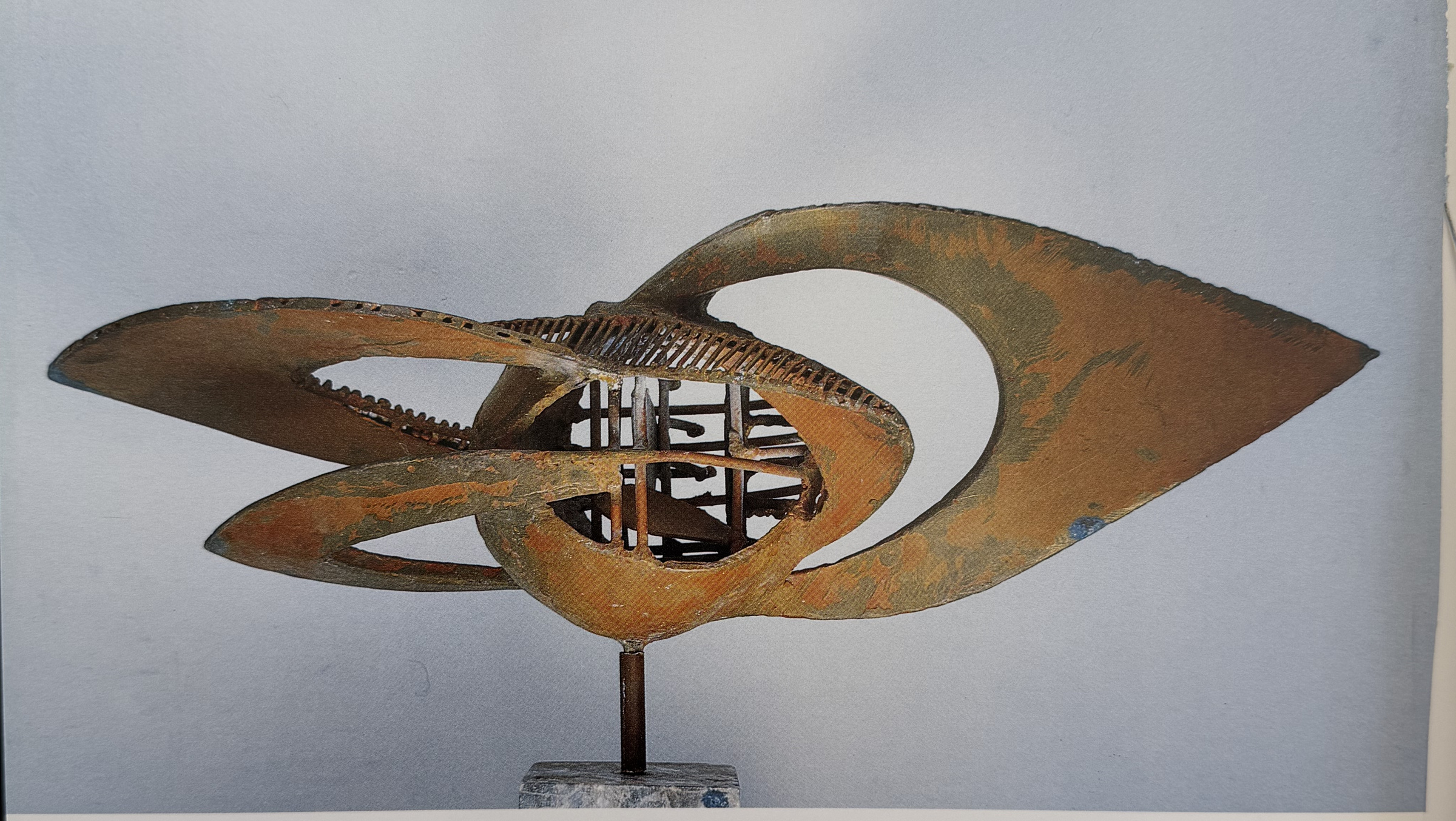
The eye’s outline extends well beyond that centre. A broad curve reaches to a point on the right; narrower forms taper towards the left. Along the upper edge of the nearer form, a row of short rods follows the curve. The title of Oeil Radar (1972) suggests an instrument for detecting what lies around it, while the object itself exposes much of its construction.
Writing in the 1999 sculpture catalogue, Francis Villadier described a reciprocal act of looking in Andreou’s open eyes:1
Eyes whose interiors we discover, which see both what surrounds them and what they are made of.
Francis Villadier, essay in Andreou: Sculpture (Bastas Editions, 1999). Translated from the French.
Eyes in relief
The eye also appears in Andreou’s reliefs, where its outline spreads across a broad surface. Here, raised edges, coloured areas, and small cavities give the interior a different depth.
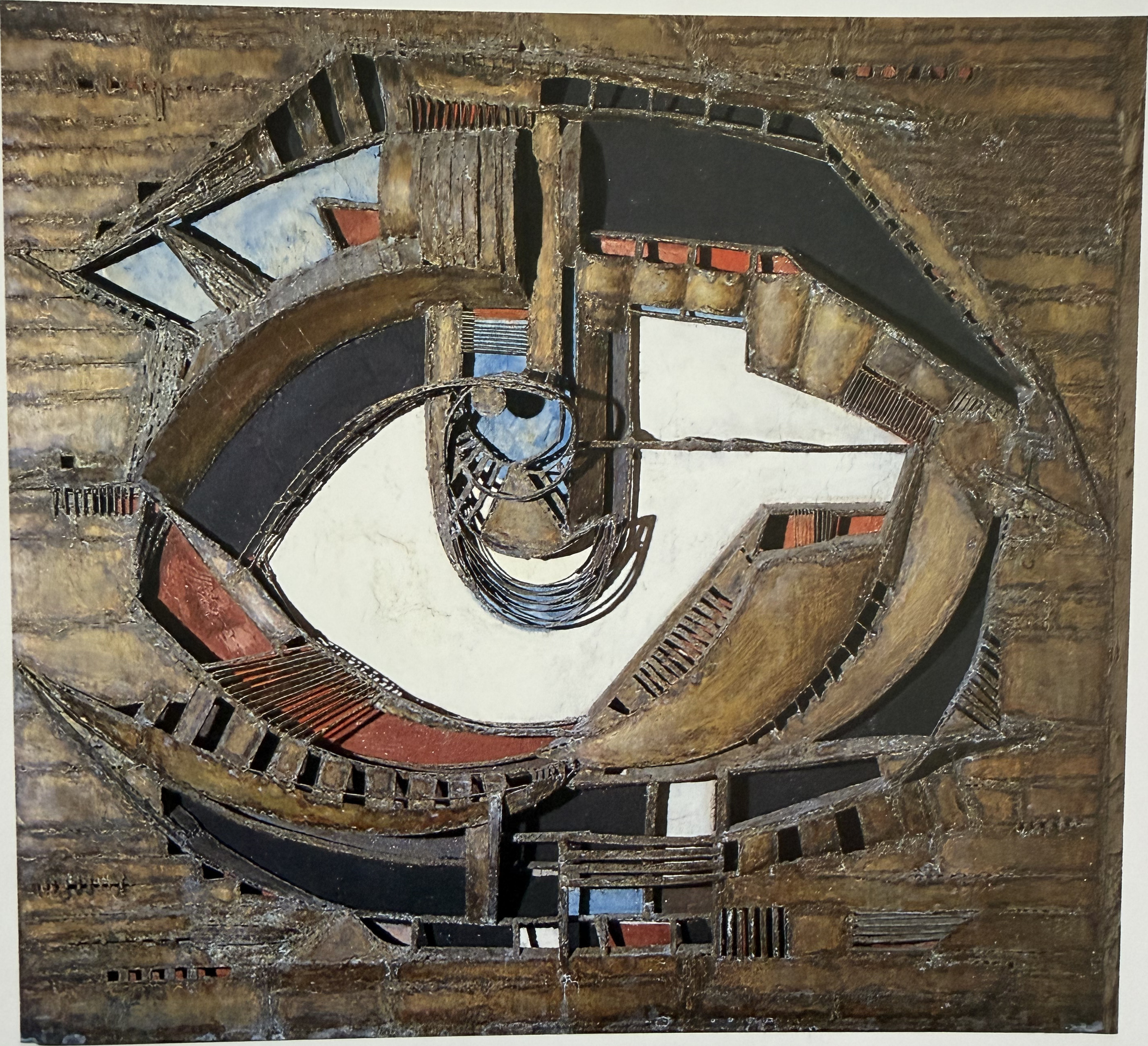
In Oeil Soleil (1965), a large pale area lies within the eye’s curved boundary. Dark bands and red patches run around it, interrupted by rows of small rectangular openings. Near the middle, curved strips hang beneath a blue form, leaving narrow gaps between their edges. Around this off-centre structure, the bands widen and narrow.
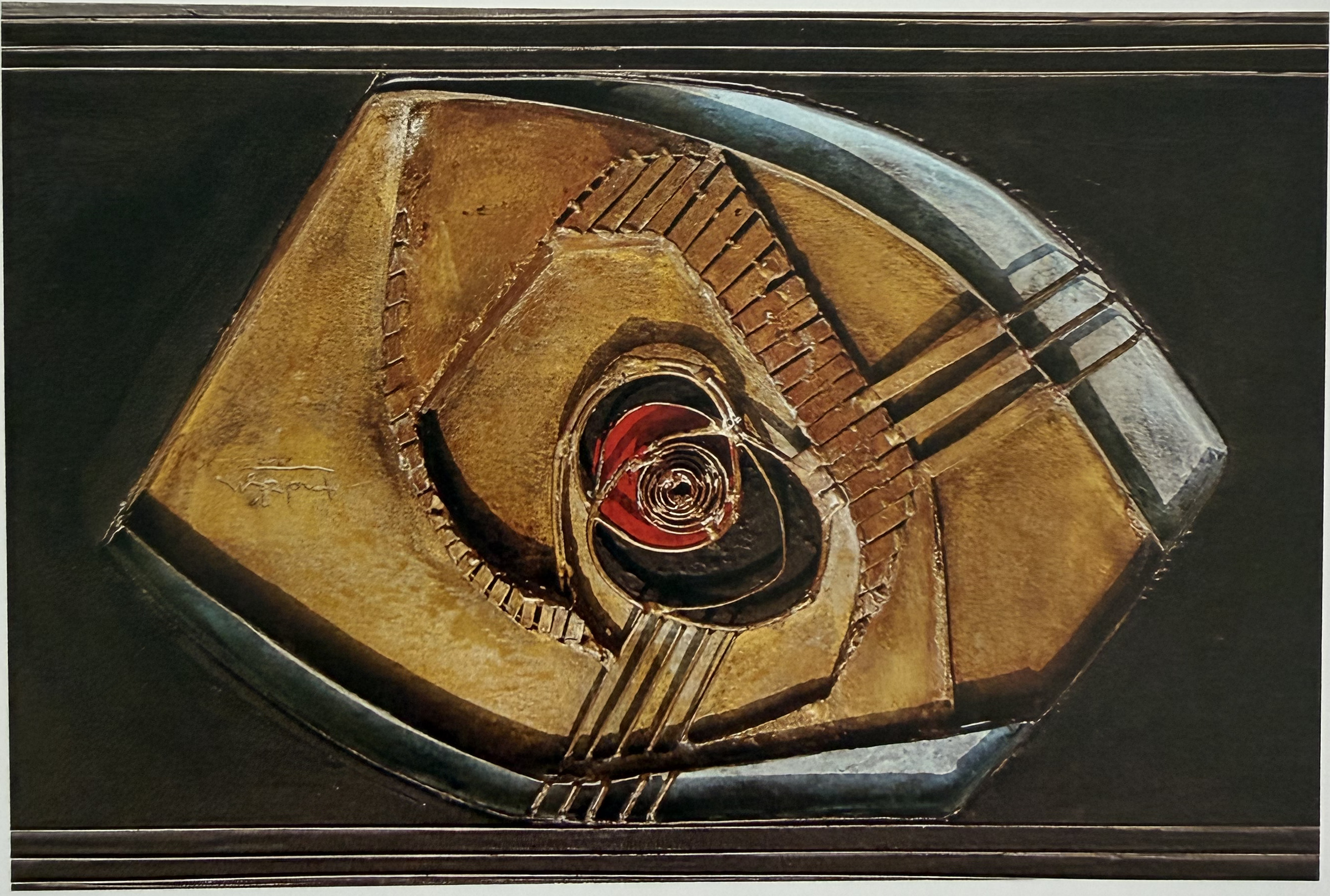
Oeil noir (1967) closes more tightly around its centre. Broad brass planes enclose a dark hollow and a red curved surface, with a small metal spiral where a pupil might be. Short ribs follow part of the inner contour. Longer bars cross it diagonally on the right and descend towards the lower edge. Their straight lines cut across the curves that gather around the spiral.
A rim of fine rods
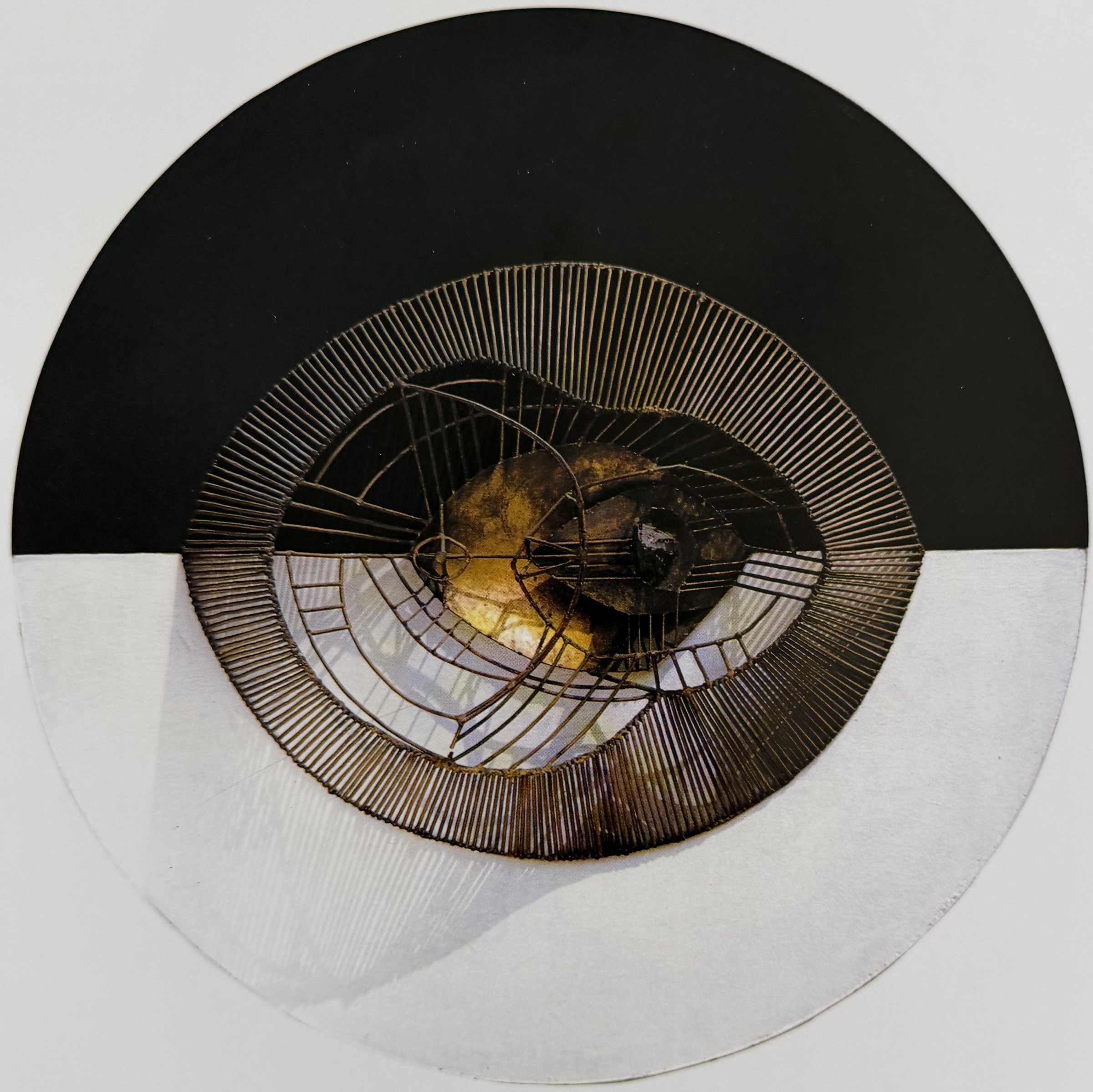
A closely spaced row of rods forms the oval rim of Oeil Prisme (1968). Inside it, curved wires project around a cluster of rounded brass forms. The rods spread out towards the rim, while the central framework crosses in several directions. In the reproduction, black above and a pale field below make different parts of this construction visible; shadows from the wires fall across the lower area.2
Villadier suggested that Andreou’s open eyes might express his persistent curiosity. In describing that curiosity, he moved from stars to cells, from literature to mathematics. These are the critic’s associations, extending the act of seeing towards things imagined or understood as well as things directly observed.1
The Musée d’Art moderne de Paris also holds an eye sculpture, L’œil (1965), acquired in 1966.3 Further museum holdings and visiting information are gathered in Where to see Constantine Andreou’s art.
Visit Discover Andreou →
Browse the catalogue →
Sources and further reading
1. Francis Villadier, essay in Andreou: Γλυπτική / Sculpture. Bas-reliefs en couleurs (Athens: Bastas Editions, 1999). The quotation and account of curiosity follow the French text. Villadier proposes a possible connection between curiosity and the open eyes; he does not identify the four illustrated works individually in this passage.
2. Artwork titles and dates follow the captions in Andreou: Sculpture (Bastas Editions, 1999); welded brass follows the book’s French technical note. The descriptions and comparisons of the four illustrated works are the Archive’s observations of their reproductions.
3. Paris Musées, Musée d’Art moderne de Paris, L’œil, 1965, inventory AMS 14; acquisition dated 22 June 1966. The museum record documents a collection holding and does not establish current display.