
Constantine Andreou’s coloured reliefs give drawn lines a physical edge. A row of rods casts narrow shadows; a curved plate shelters a patch of red. Colour appears on broad surfaces and between projecting pieces of metal, sometimes partly concealed by them.
In his account of Andreou’s studio at La Ville-du-Bois, Francis Villadier moved from paintings and drawings to the tools and unfinished pieces of the sculpture workshop. He described the reliefs as works that “bring together form and colour, sculpture and painting”. For Villadier, Andreou adapted his ideas to each material while retaining a recognisable manner across them.1
Colour between the edges
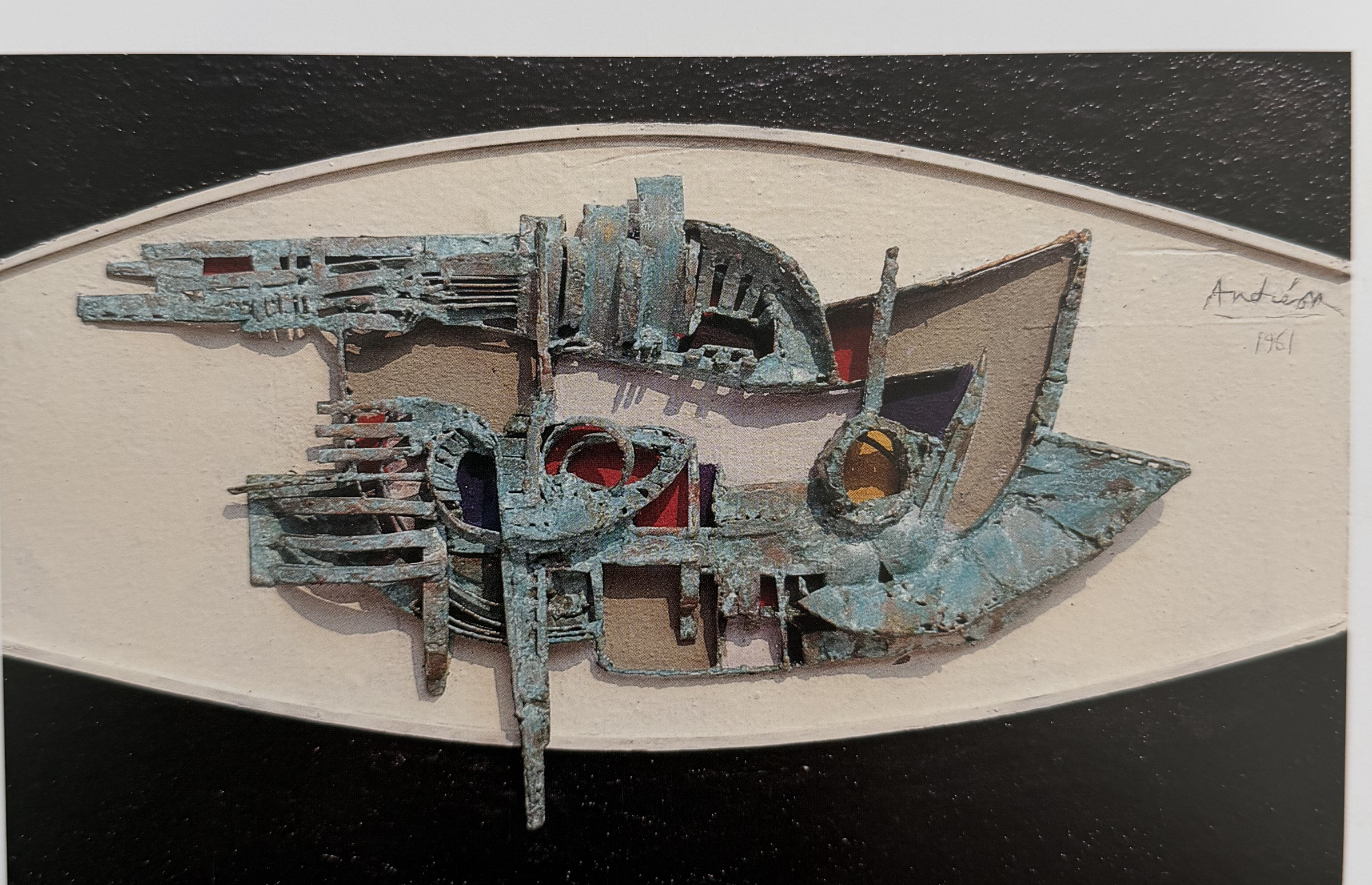
Prisme (1961) extends horizontally across a pale oval field. Its blue-green metal strips enclose small areas of red and violet. Near the centre, rounded rims surround coloured recesses; towards the right, a tall angled plate rises beside a smaller ochre area. Closely spaced bars stretch out to the left.
Shadows make the projecting edges particularly clear in this reproduction. Beneath the upright plates, they fall across a pale violet surface. The small red passages sit deeper within the structure, bordered and partly covered by metal.
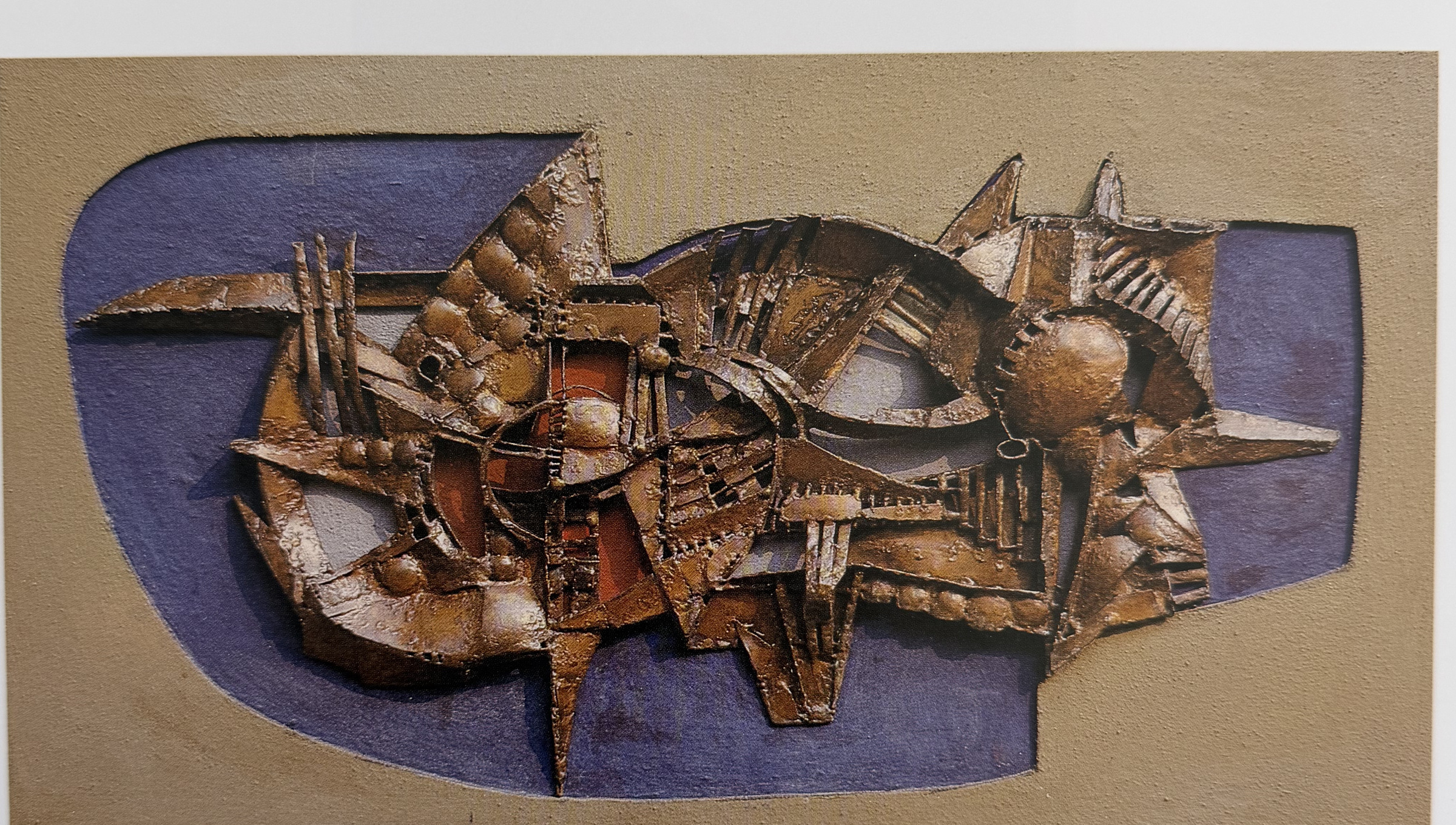
In Danse d’Oiseau (1962), the blue-violet field remains visible around the metal and through several spaces within it. Broad curves loop around rounded bosses, while pointed plates project above and below the main horizontal arrangement. Thin bars cross the curves at different angles. Small red areas punctuate the crowded centre; along the outer edges, shadows spread onto the surrounding colour.
Circles and crossings
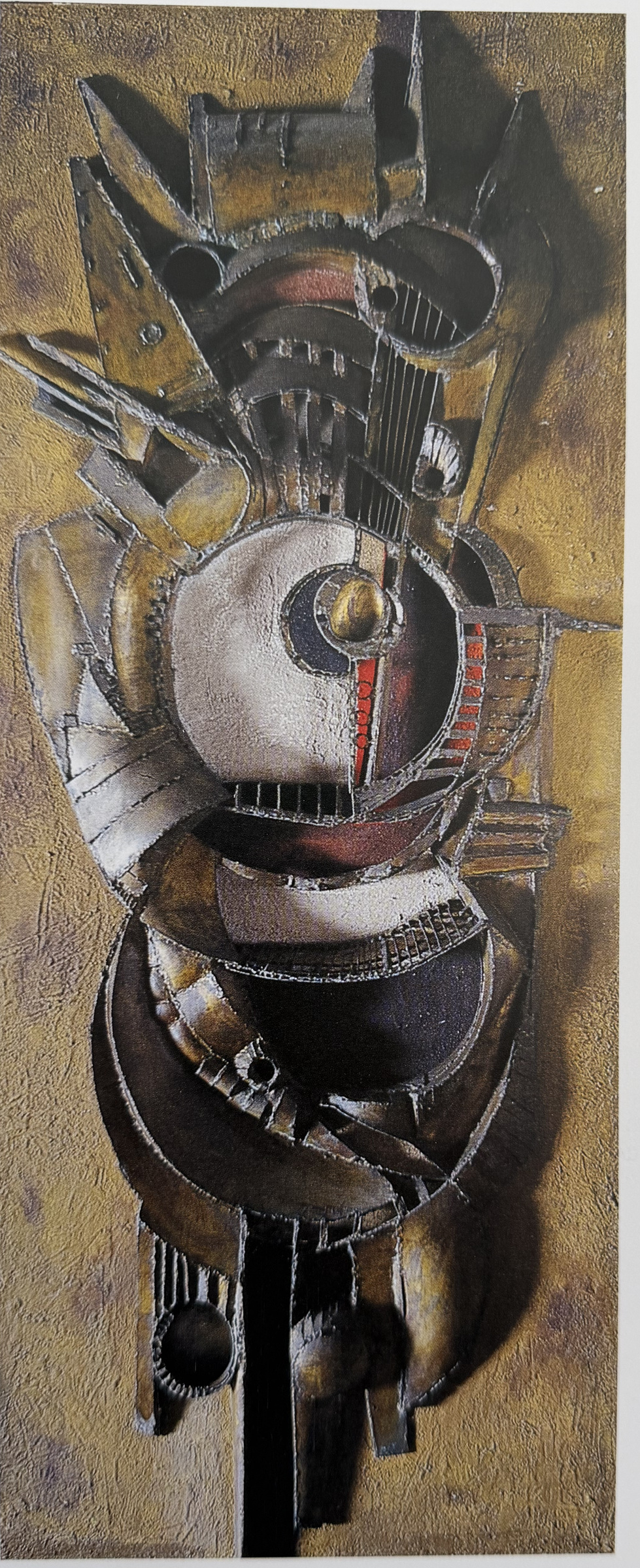
A large pale circular form occupies the middle of Soleil Roi (1963), with a small raised disc near its right edge. Curved bands pass around and beneath it. A row of red rectangles follows the outer curve on the right, while another narrow red passage cuts down beside the disc. Above and below, the composition breaks into pointed plates, small round openings, and rows of fine rods.
The red accents trace parts of the structure through a much larger area of pale, brown, and gold tones. Their repetition follows the segmented edges of the metal, giving the colour a rhythm tied to the relief’s construction.
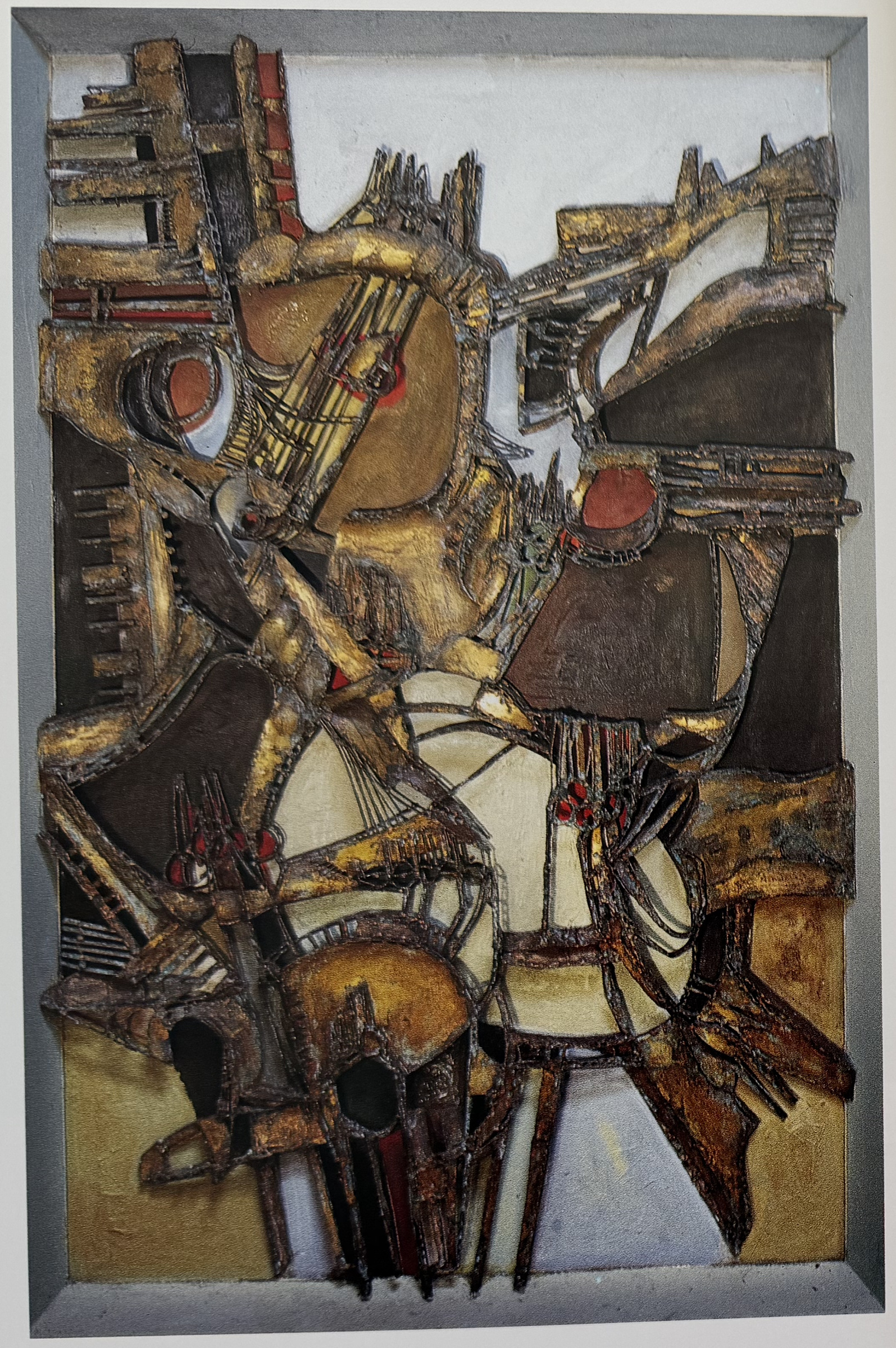
Symphonie d’oiseau (1963) fills a rectangular field with crossing directions. Groups of parallel rods run vertically, horizontally, and diagonally between broad curved plates. Pale areas separate some forms and open up the dense arrangement. Red appears in a strip near the upper left, in rounded patches, and in smaller marks caught between the rods.3
A painter’s concerns
Writing about his painting in Femme · Femmes: Peintures (1997), Andreou described a search for harmony among graphic marks, drawing, colour, and light. He used the word “symphony” for their relationship.2 In the reliefs, a raised line catches light along its edge and casts a shadow onto the colour below.
In Symphonie d’oiseau, some red areas remain fully exposed; others are crossed by rods or tucked beneath a curved edge. The metal determines how much of each coloured area comes into view.
Visit Discover Andreou →
Browse the catalogue →
Where to see Constantine Andreou’s art →
Sources and further reading
1. Francis Villadier, essay in Andreou: Γλυπτική / Sculpture. Bas-reliefs en couleurs (Athens: Bastas Editions, 1999). The short quotation is translated from the French passage describing the reliefs in Andreou’s studio. The account of adapting ideas to different materials also follows Villadier’s text.
2. Constantine Andreou, signed artist’s statement in Andreou. Femme · Femmes: Peintures (Édition G. Giannoussis, 1997), beginning “Depuis mon enfance…”. His statement concerns painting. The comparison with the illustrated reliefs is the Archive’s reading, rather than a claim that he was describing these particular works.
3. Artwork titles and dates follow the captions in Andreou: Sculpture (Bastas Editions, 1999); welded brass follows the book’s French technical note. The descriptions and comparisons of the four illustrated reliefs are the Archive’s observations of their reproductions.