
A reclining woman stretches across blue in one of Constantine Andreou’s paintings titled Vitrine d’Amsterdam. In the other work shown here, pale faces and bent limbs fill a tall, mauve frame. Dark divisions cross the figures and the space around them.
In her essay “Vitrines d’Amsterdam”, published in Femme · Femmes: Peintures (1997), Sophia Kazazi describes women displayed in windows for paid sexual encounters. She considers the tension between desire and transaction. In her reading, Andreou’s use of light and pictorial invention restores dignity to women presented as objects of exchange. Describing the woman’s changing appearance within the painting, she writes:
She is transformed into signs inscribed in an undefined space, structured by vertical or horizontal planes.
Sophia Kazazi, “Vitrines d’Amsterdam”, in Femme · Femmes: Peintures (1997). Translated from the French.
Across a field of blue
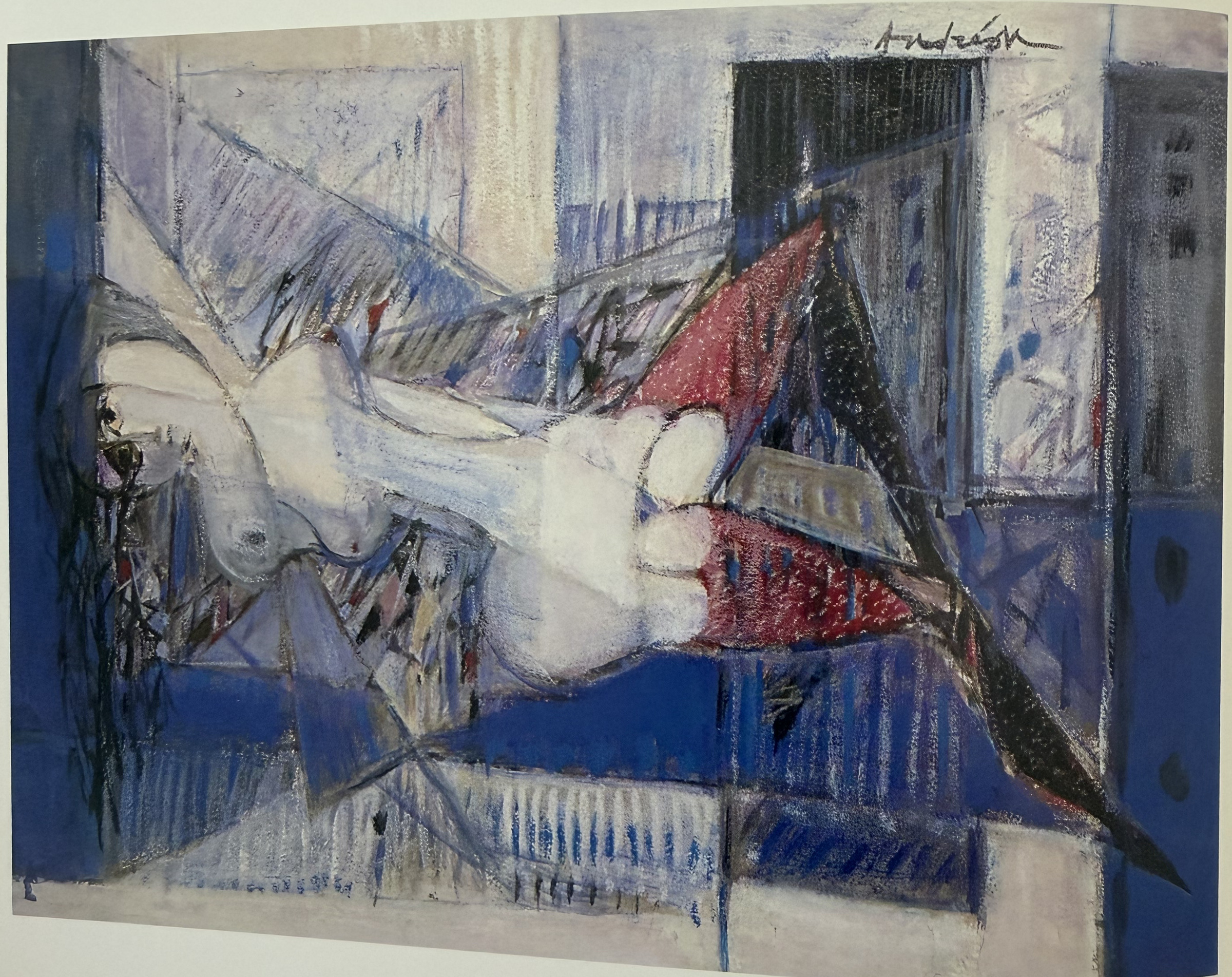
In Vitrine d’Amsterdam (1974), the head lies close to the left edge and the pale torso stretches through the centre. Red and black angular shapes occupy the right. Behind and beneath the body, vertical bands of blue and grey are crossed by long diagonals.
The body stands out against the blue, though its curved outline is interrupted by the surrounding planes. Blue reappears beneath the figure and among the red and black shapes, continuing across compartments divided by the drawing.
A taller frame
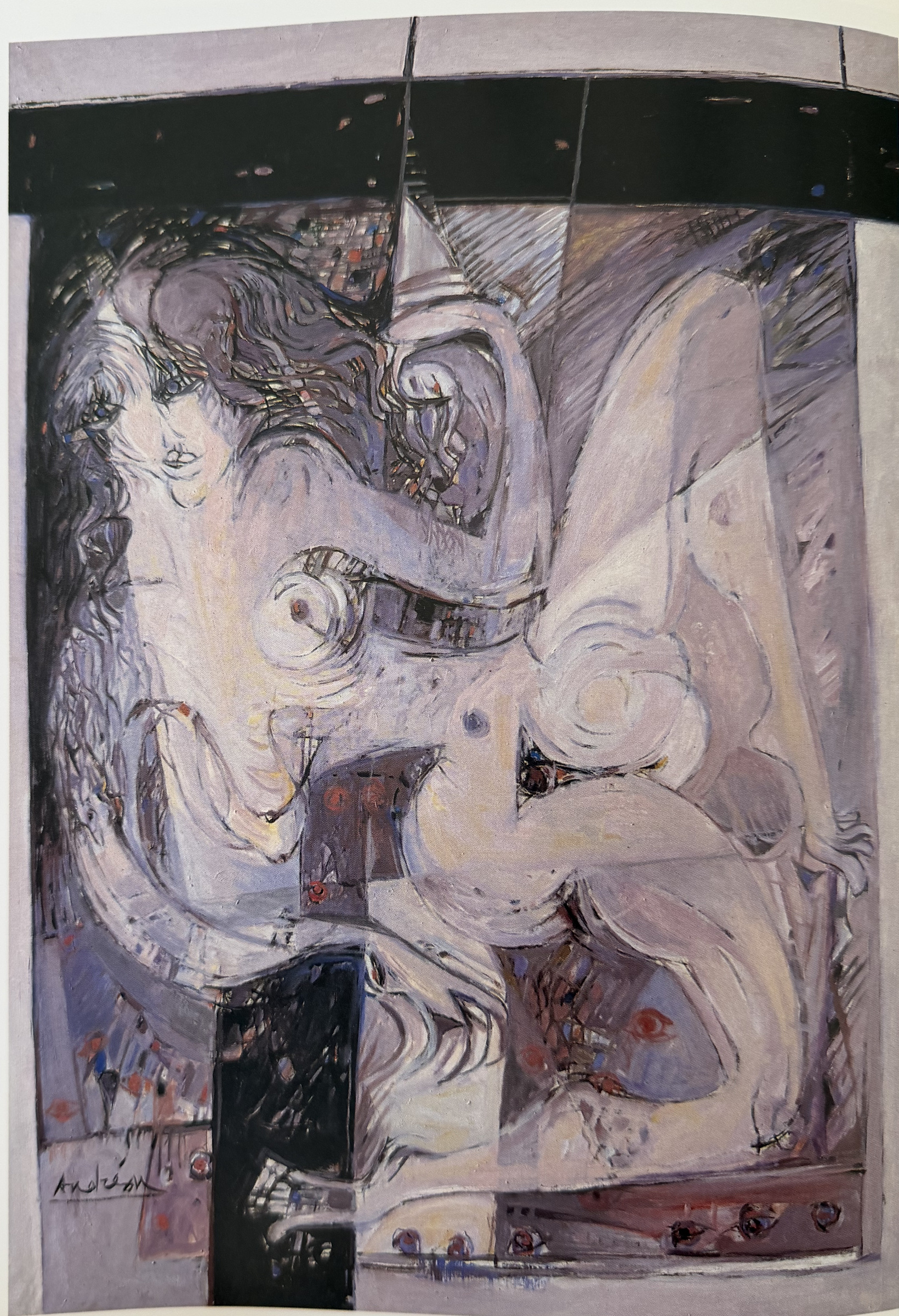
Vitrine d’Amsterdam (1980) is painted in mauve, grey, and cream, with pale faces and bent limbs filling a tall composition. A broad black band crosses the top. Narrow vertical divisions and smaller dark rectangles interrupt the curved forms below.
Curves around eyes, shoulders, and breasts are edged with small, dark marks. Some outlines remain clear; others merge with the dense drawing between the figures.
The spectator’s gaze
Kazazi asks whether the crowd’s sensual gaze accounts for the distortion of the nude in the window. She leaves this as a question about desire and perception.
Kazazi’s interest in how drawing shapes space predates the 1997 book. In a 1988 introduction to Andreou’s work, she emphasised the architectural construction of his compositions and the interplay of space and form. She mentioned “Windows” alongside nudes and Amour des vagues, without identifying either painting shown here.
André Perrot, writing as a friend of the artist in the 1997 book, warns against dividing the paintings into fixed themes. He connects the Amsterdam windows with women who become waves or clouds, mothers protecting children, figures in hammocks, and women looking into mirrors. He sees these subjects as connected by colour, light, and the continual remaking of the female image.
The doubled faces in Women and mirrors and the reclining bodies in Amour des vagues: women and the sea show two of the connections Perrot describes.
Sources and further reading
1. Sophia Kazazi, “Vitrines d’Amsterdam”, signed “Sophie Kazazi”, in Andreou. Femme · Femmes: Peintures (Édition G. Giannoussis, 1997), unpaginated. The quotation is translated from the French. The account of the women’s display, pictorial transformation, and the spectator’s gaze follows her interpretation.
2. Artwork titles and dates follow the catalogue records and corresponding reproductions in Femme · Femmes: Peintures. The close descriptions of the two paintings are the Archive’s observations of those reproductions.
3. André Perrot, untitled essay, in Andreou. Femme · Femmes: Peintures (Édition G. Giannoussis, 1997), unpaginated. His discussion explicitly connects the Amsterdam subject with other recurring female figures and cautions against rigid thematic divisions.
4. Sophia Kazazi, “Στάσεις. Εικαστικά. Εισαγωγή στο έργο του Ανδρέου” [“Introduction to Andreou’s work”], Το Τραμ, nos. 4–5 (January 1988), pp. 185–186. Digitised by the Centre for the Greek Language. The article names a “Windows” group without identifying the two paintings reproduced here.