
Brass takes the form of both surface and line in Constantine Andreou’s sculpture. Broad plates establish an outline, while rods and wire cross the spaces within it. Openings expose the construction and let the background become visible through the work.
In a statement published in Andreou: Sculpture (1999), Andreou recalled beginning with marble carving and clay modelling. Working in welded brass gave him the means to invent unexpected forms.1 He described a process that reached beyond the surface:
With brass wire I draw both the inside and the outside in space.
Constantine Andreou, artist’s statement in Andreou: Sculpture (Bastas Editions, 1999), p. 237. Translated from the French.
A preparatory drawing gave Andreou a starting point. He cut and hammered the metal, then welded the pieces together. Mortaki quotes his explanation that the finished work recalled the drawing without reproducing it exactly2.
In her 2008 lecture on sculpture in France after 1945, Lydia Harambourg linked Andreou’s welded brass plates with airy forms that let light through.3
A figure in planes
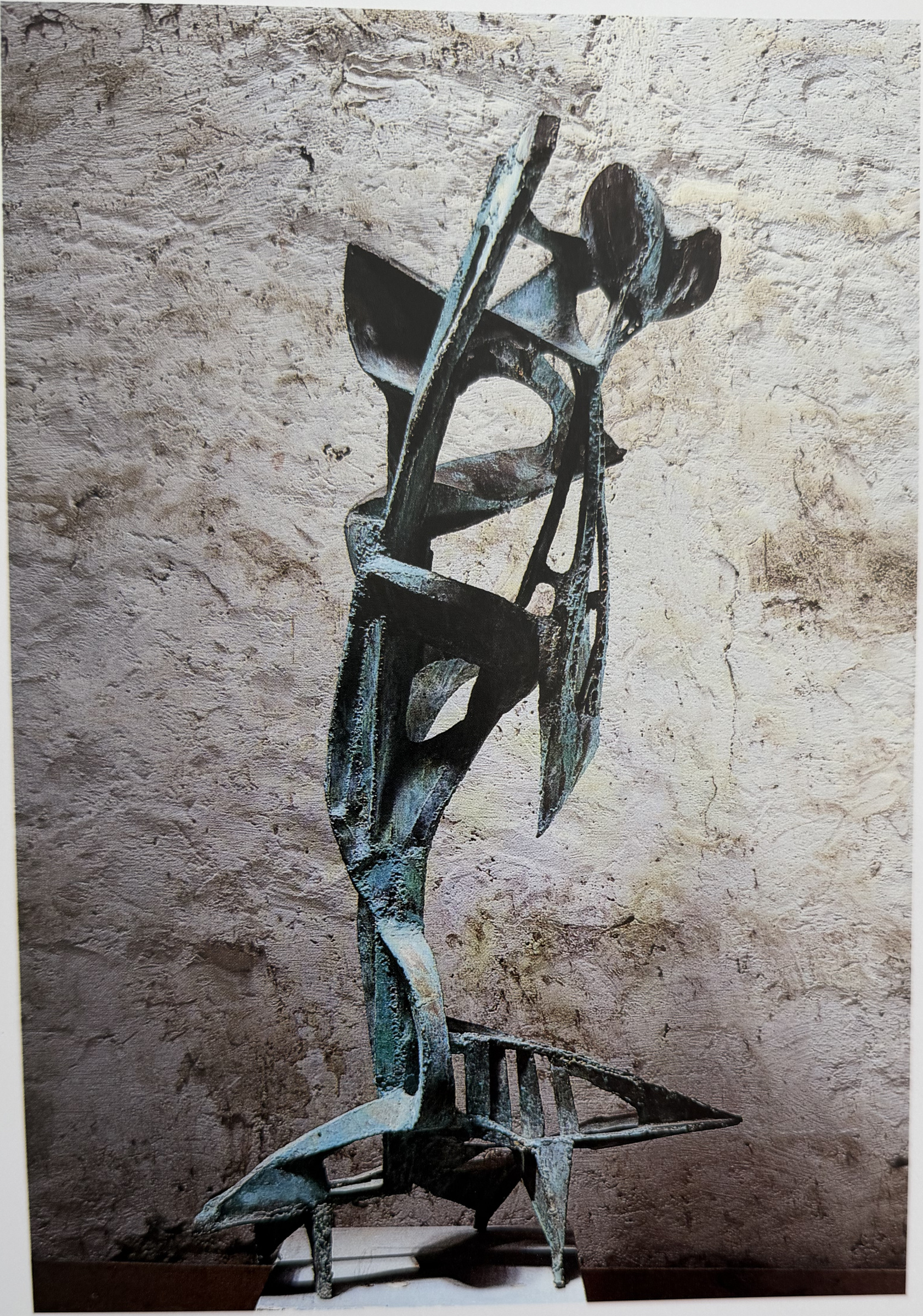
In Flamenco (1958), curved plates and narrow strips rise from an open framework. A long diagonal cuts across the centre, beside a rounded opening through which the wall behind is visible. Thin edges catch the light; broader planes appear almost black. Near the base, horizontal rods spread out beneath the narrow upright form.
The National Gallery of Greece describes Andreou’s sculpture as keeping contact with recognisable subjects while introducing abstract, surrealist, and expressionist elements. Its account includes human figures, animals, and birds.4 In Flamenco, the suggestion of a figure remains in the upward movement and tilted planes, even where its body is difficult to trace.
The space inside
In another recollection reproduced by Mortaki, Andreou described making birds as skeletal frameworks and then beginning to fill the form again. He saw this as a dialogue between exterior and interior2.
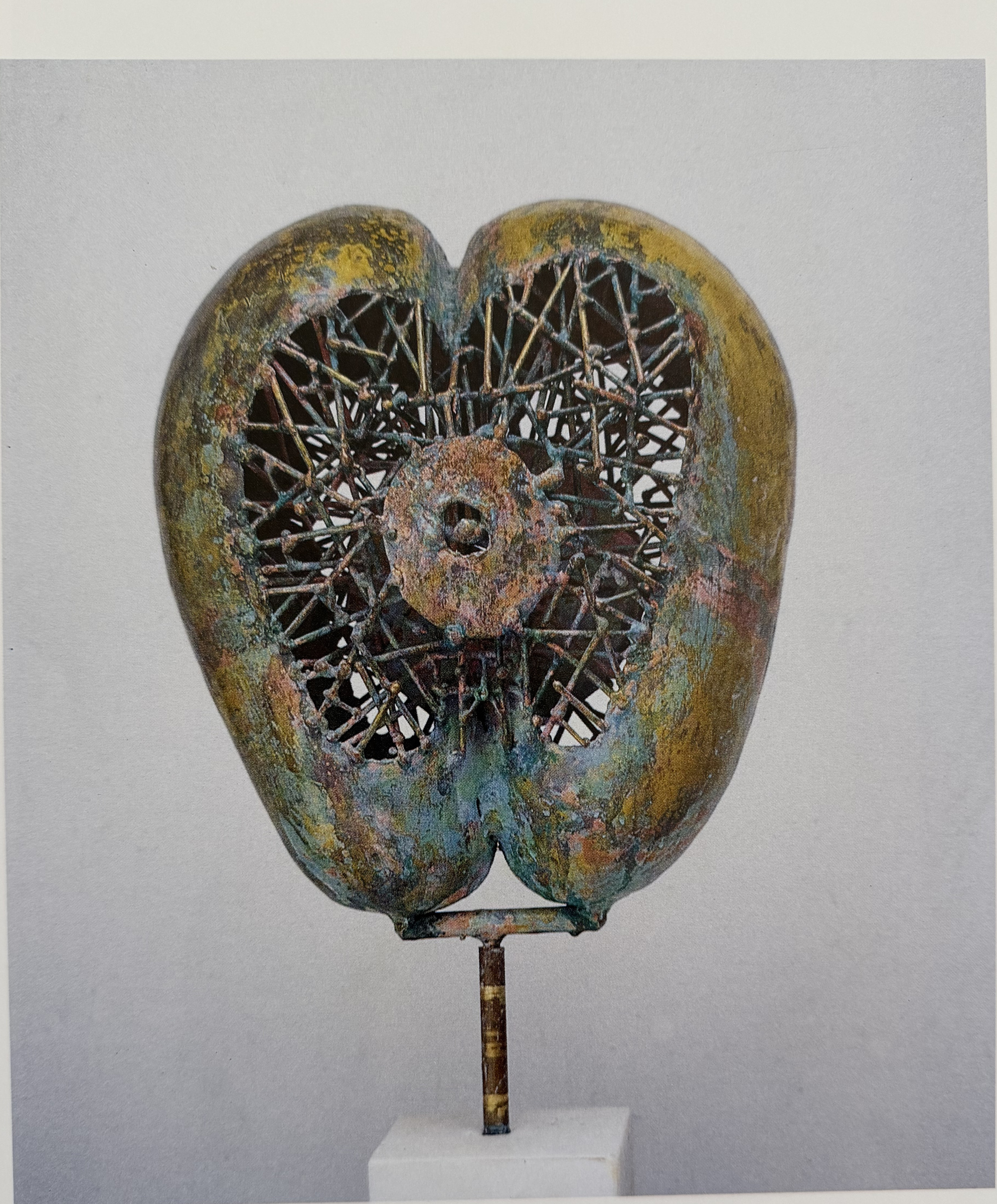
Germination (1994) gathers its elements into a compact, rounded form. Two shell-like surfaces surround a web of rods and a toothed disc. The rods radiate, cross, and join in several directions, leaving small triangular and irregular gaps. At the top and bottom, the two lobes of the outer contour draw close together.
The pale background shows through the framework, but some crossings are dense enough to conceal what lies behind them. Broad areas of the shell alternate with this crowded interior. The difference between surface and opening is visible across the whole form, from its outer edges to the small hole in the central disc.
Jean Cathelin gave empty space equal importance to solid form in his account of Andreou’s welded-brass sculpture and reliefs. His text is reproduced in the 1997 volume Femme · Femmes: Peintures.5 In Germination, the gaps have shapes as varied as the pieces of metal around them.
Building upwards
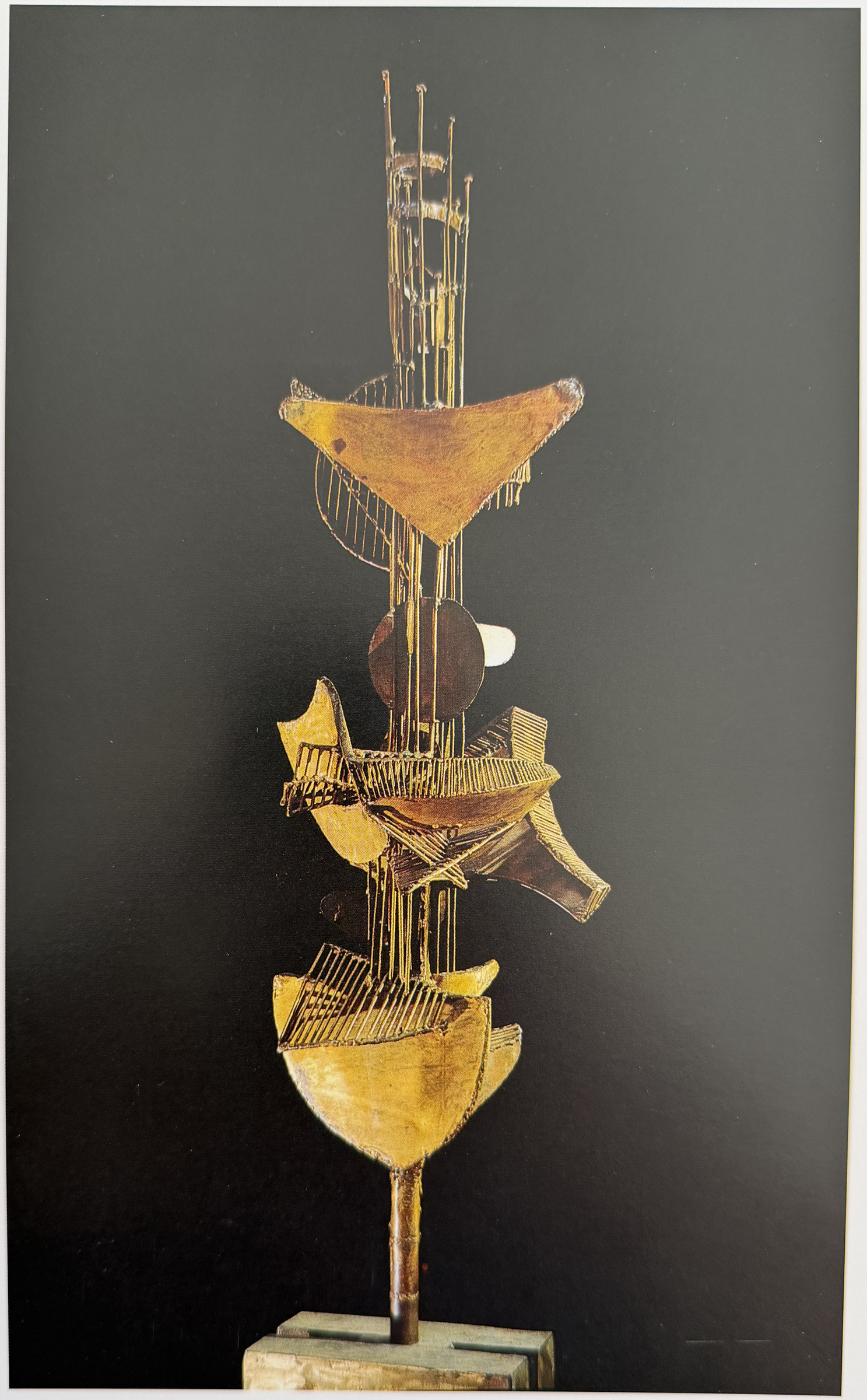
In Colonne ouverte et évolutive (1971), long vertical rods run through a succession of projecting forms. A broad triangular plate spreads across the upper part. Below it, curved plates, round shapes, and rows of closely spaced bars interrupt the upright lines. Some sections are dense; others leave the rods exposed against the dark background.
The rods maintain a continuous direction through these changes in width and density. Near the lower part, a broad curved surface gathers the structure into a bowl-like form. Higher up, projecting edges reach out on either side of the central bundle.
At the top, individual rods continue beyond the last broad plate. The column ends in separate lines, with space between them. Andreou’s description of drawing in space is particularly tangible here: a line has thickness, casts a shadow, and can be seen against whatever lies beyond it.6
Visit Discover Andreou →
Browse the catalogue →
Where to see Constantine Andreou’s art →
Sources and further reading
1. Constantine Andreou, statement signed “Andreou Constandinos”, in Andreou: Γλυπτική / Sculpture. Bas-reliefs en couleurs (Athens: Bastas Editions, 1999), p. 237. The quotation is translated from the French. The account of his early materials and his work in welded brass follows his own recollection.
2. Sapfo A. Mortaki, Η καλλιτεχνική μετανάστευση στην Ελλάδα: από τον 19ο στον 20ό αιώνα (1870–1970): η περίπτωση του Κωνσταντίνου Ανδρέου, doctoral thesis, Aristotle University of Thessaloniki, 2010, main volume, pp. 286 and 309–310. The passages combine Mortaki’s description of his working process with the artist’s recollections quoted from earlier publications. They concern his practice generally and do not identify Germination.


3. Lydia Harambourg, “La sculpture en France après 1945”, lecture to the Académie des beaux-arts, 5 March 2008; transcript published by the Institut de France, 6 April 2008. The passage on Andreou appears in the section “Les sculpteurs de métal”.
4. National Gallery – Alexandros Soutsos Museum, “Ανδρέου Κωνσταντίνος” [Constantine Andreou], undated artist entry. Its account of figurative subjects and abstract, surrealist, and expressionist elements concerns his sculpture generally.
5. Jean Cathelin, critical extract reproduced in Andreou. Femme · Femmes: Peintures (Édition G. Giannoussis, 1997). His observation concerns welded-brass sculpture and reliefs generally; it is not a commentary identifying Germination.
6. Artwork titles and dates follow the captions in Andreou: Sculpture (Bastas Editions, 1999); welded brass follows the book’s French technical note. The descriptions and comparisons of the three illustrated works are the Archive’s observations of their reproductions. General statements by the artist and critics are distinguished from commentary on an individual work.