
Constantine Andreou’s wave paintings make the outline of a reclining woman difficult to separate from the sea. Curves that describe a shoulder or hip continue through the surrounding water.
Amour des vagues names both a recurring theme and individual paintings. The three works shown here date from the 1980s and 1990s: two are predominantly blue, while Femme vague uses ochre and cream.
The body becomes water
In her essay “Amour des Vagues”, published in Femme · Femmes: Peintures in 1997, Sophia Kazazi describes bodily form passing into the movement of the sea:
The wave becomes Woman and Woman becomes wave.
Sophia Kazazi, “Amour des Vagues”, in Femme · Femmes: Peintures (1997). Translated from the French.
Kazazi reads this transformation in erotic terms. She describes circles opening into spirals and undulations, with Andreou’s dense drawing allowing fluid and solid forms to pass into one another. Her references to the sirens and Ulysses associate the women’s sensual appeal with the danger of being overwhelmed.
Kazazi traces the painted series back to 1976 and the related siren and wave sculptures to 1956. In her account, Andreou had worked with these subjects in sculpture before taking them up in painting.
Three paintings
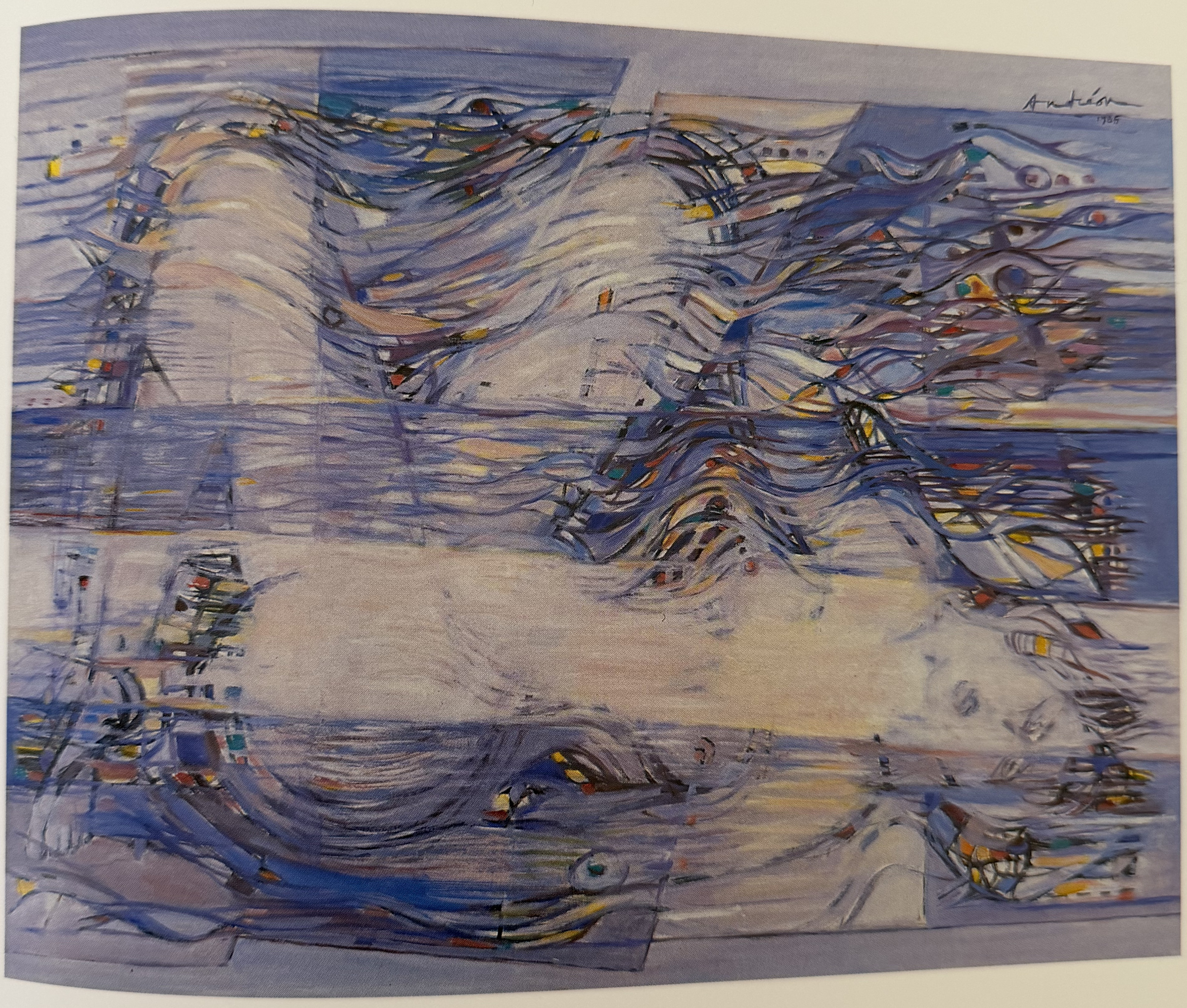
In Amour des vagues (1983), a large pale figure lies across the lower half, her face near the right edge. Above her, blue and lavender bands curl around further bodily forms. Short bright dashes punctuate the surface. The broad, lightly coloured body is easy to recognise, while the denser lines above it make the other figures harder to disentangle.
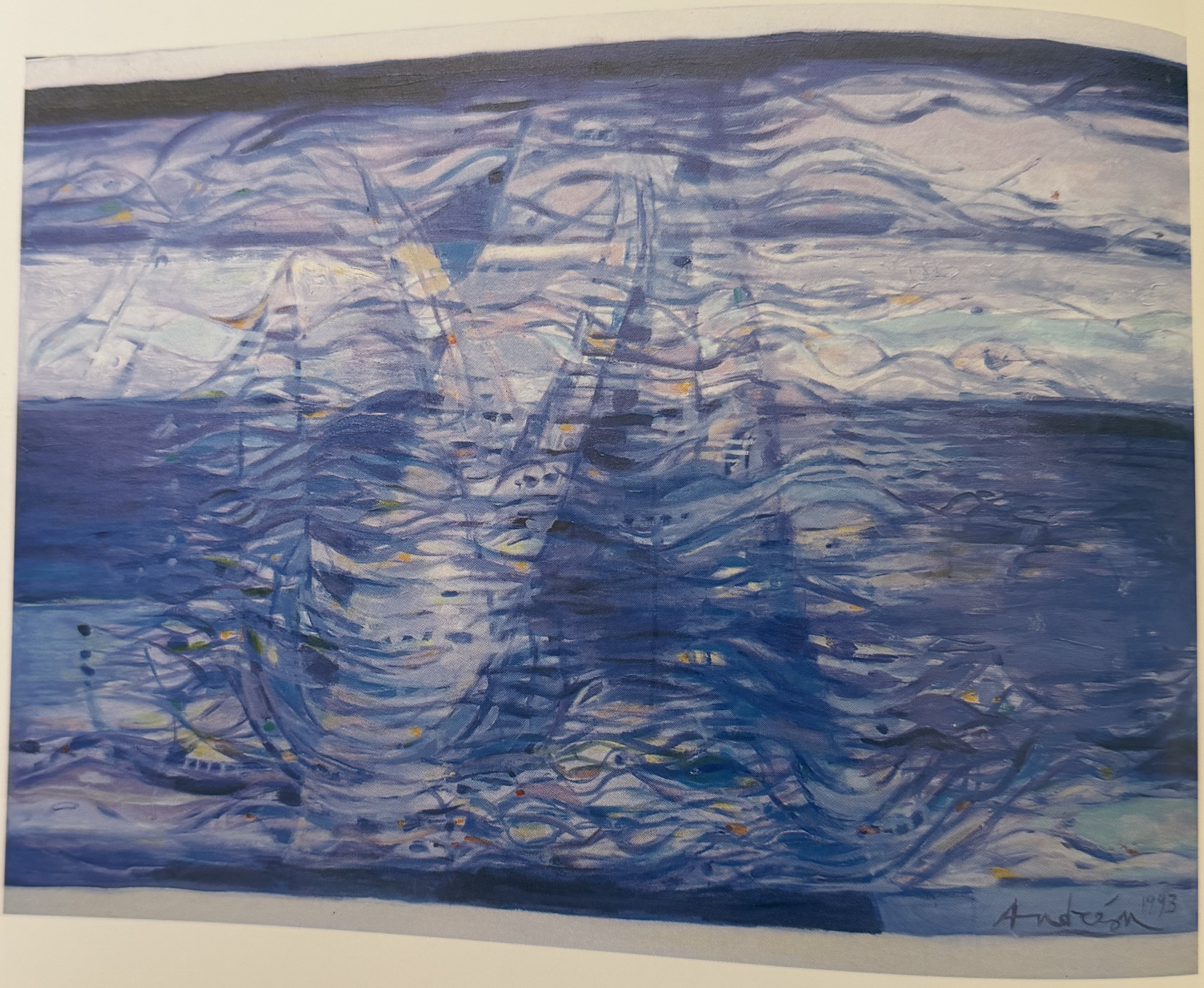
The blue is deeper in Amour des vagues la nuit (1993–94), and a broad dark band crosses the middle. Pale forms are partly submerged in this field of colour. Fine lines and scattered bright marks pick out fragments of bodies, though a face or torso can be difficult to distinguish from the surrounding blue.
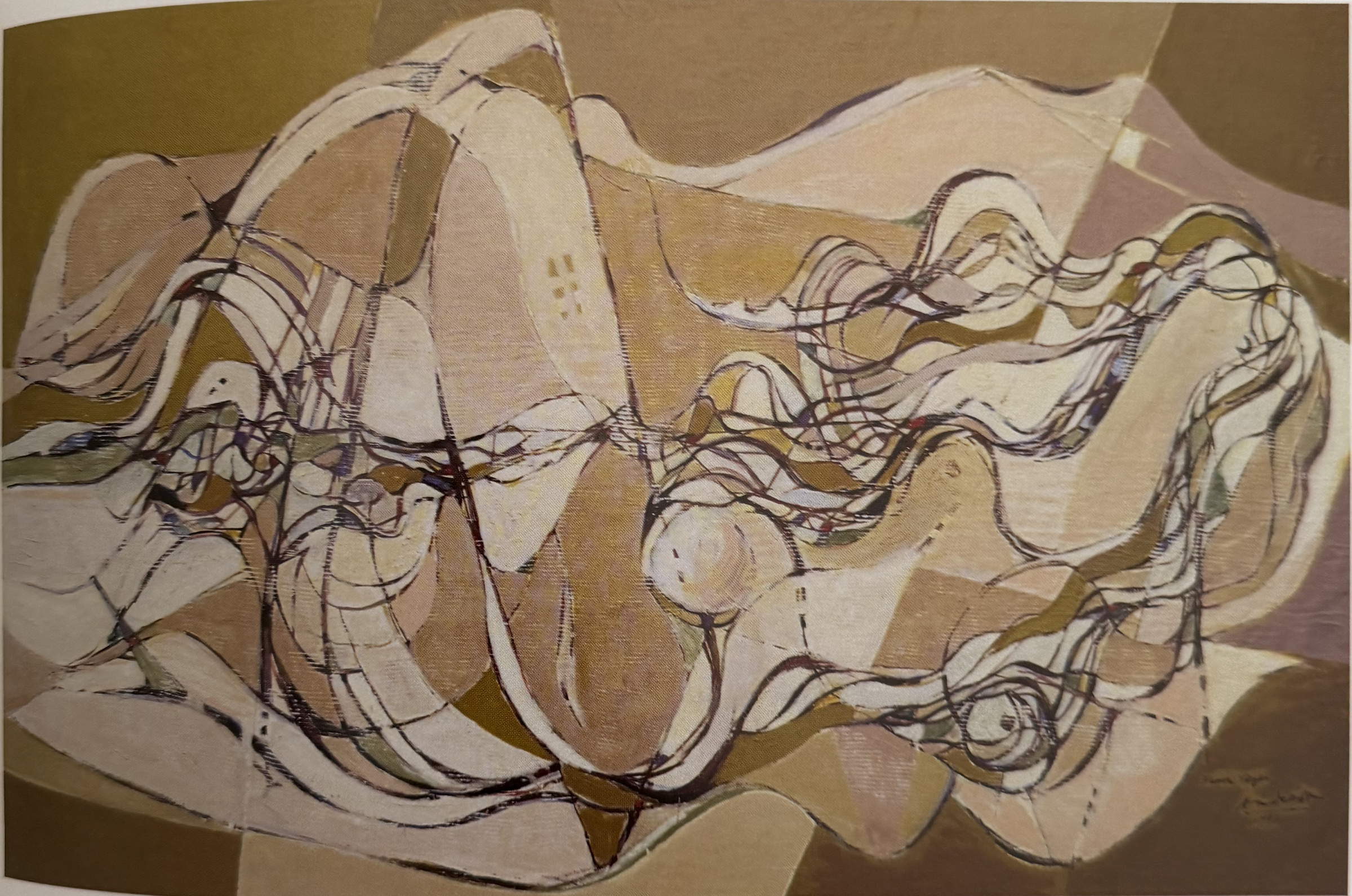
Femme vague (1991) uses ochre, cream, and muted pink. Dark contours sweep across broad, relatively open areas of colour; in places, several lines run alongside one another before separating. A breast, a face, or the bend of a leg appears within this continuous drawing. Here the resemblance to waves lies chiefly in the rise and fall of the outlines.
A Mediterranean memory
Art historian Sapfo Mortaki interprets the sea, waves, and sirens as Mediterranean memories carried into Andreou’s work in France. She places them within his experience of the Greek diaspora, arguing that this inheritance continued to shape his experiments with modern forms and materials.
Lines and signs
At the end of her essay, Kazazi connects the theme’s sensual intensity with Andreou’s continuing search for harmony. His own statement in Femme · Femmes describes the exchange between first sensations and their translation into lines and signs. He compares this process to musical writing and speaks of harmony among graphic marks, drawing, colour, and light.
André Perrot, a friend of the artist writing in the same book, sees a storm of passions beneath the sea’s apparent calm. He also resists a strict division of the paintings into themes. His discussion moves from the woman who becomes a wave to women imagined as clouds, mothers, and figures before mirrors.
Sources
1. Sophia Kazazi, “Amour des Vagues”, in Andreou. Femme · Femmes: Peintures (Édition G. Giannoussis, 1997), unpaginated. The French essay is signed “Sophie Kazazi”; the volume’s contributor credits use “Sophia Kazazi”. The quotation is translated from the French. The chronology, reciprocal transformation, and mythic interpretation follow her account; its dates concern the theme rather than identifying individual works.
2. Constantin Andreou, untitled signed artist’s statement beginning “Depuis mon enfance…” in the same volume. The discussion of sensations, lines, signs, musical writing, and harmony paraphrases his French text.
3. André Perrot, untitled essay in the same volume. His account provides the reading of the sea’s apparent calm and its connections with the wider painting themes.
4. Sapfo Mortaki, “Intercultural references: the influence of the Mediterranean on the work of Constantine Andreou, artist of the Greek Diaspora”, Mediterranean Chronicle 5 (2015), pp. 245–262, especially pp. 247–251 and 254–255. Figure 5 (p. 258) reproduces the 1983 composition illustrated here as CAA-W-0059 under the title Femme et l’eau; this page retains the 1997 book’s caption title, Amour des vagues.
5. Artwork titles and dates follow the corresponding reproductions in Femme · Femmes: Peintures. Titles and years alone do not identify individual works. The close descriptions and comparisons are the Archive’s observations of those reproductions.