
In Constantine Andreou’s kiss paintings, noses and mouths meet along a dense strip of marks. Pale faces stand against black and violet in Le Baiser, and red and orange surround the heads in Baiser rouge. Couple places its faces at different heights.
In “Le baiser”, published in Femme · Femmes: Peintures (1997), Sophia Kazazi dates the first appearance of the kiss theme to 1973. She describes both close views of heads and compositions with whole figures. The circular movement of the drawing suggests to her that the lovers occupy a space with no exit. She asks:
Is this ardour, both strong and tender, a sign of protection or a final farewell before death?
Sophia Kazazi, “Le baiser”, in Femme · Femmes: Peintures (1997). Translated from the French.
Faces in close-up
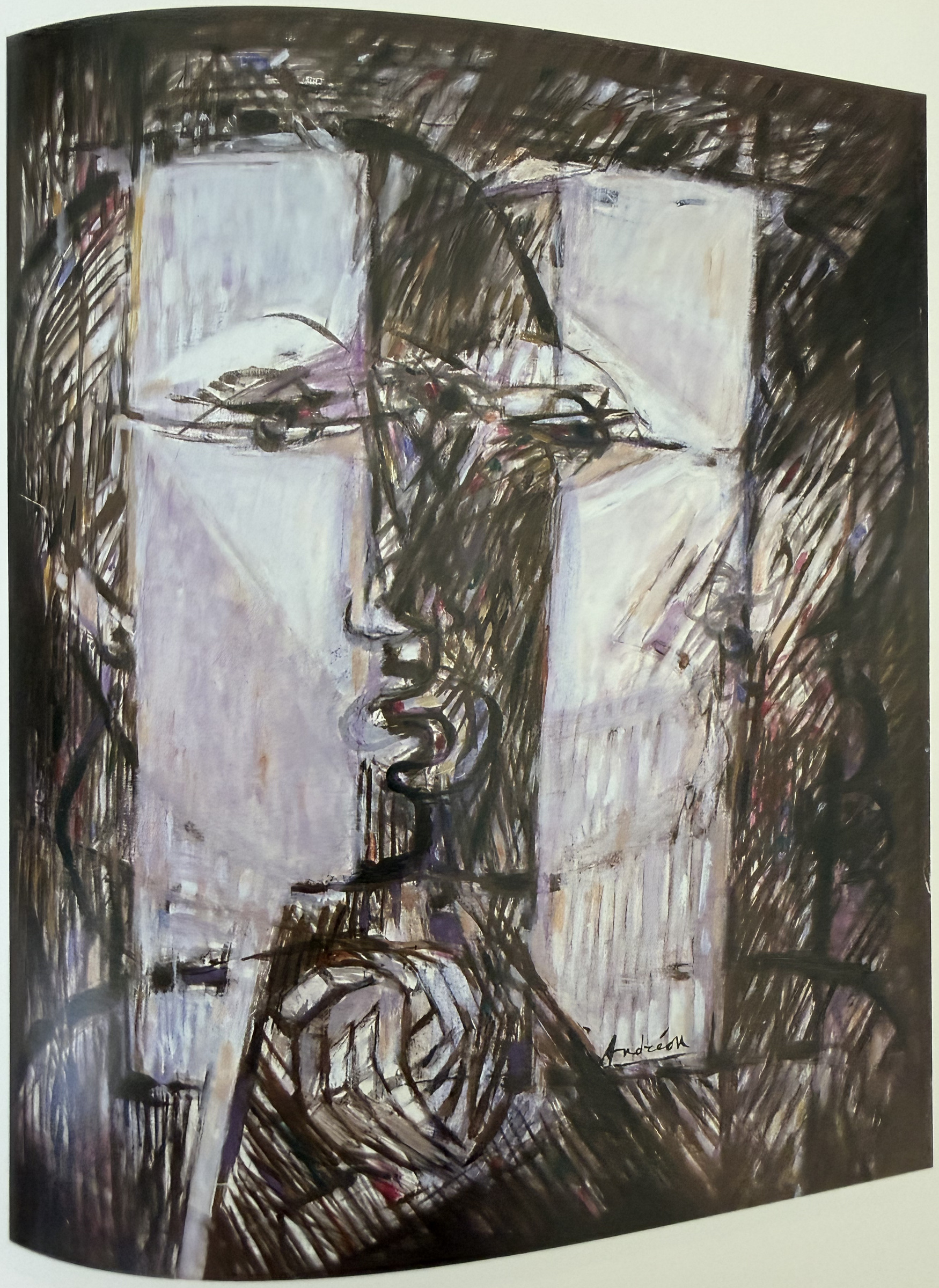
In Le Baiser (1977), two pale faces fill almost the whole painting. Their eyes are nearly level, and their noses and mouths meet along a dark vertical strip. Black, brown, and violet strokes surround the broad cheeks. Below the mouths, a large curved form is divided by shorter, crossing marks.
Kazazi compares Andreou’s treatment of the kiss with works by Füssli, Munch, and Klimt, and with Picasso’s L’Étreinte. She emphasises his distinct handling of line and light. In her reading, the dark tonal gradations and dense graphic marks give his kiss paintings a tragic intimacy.
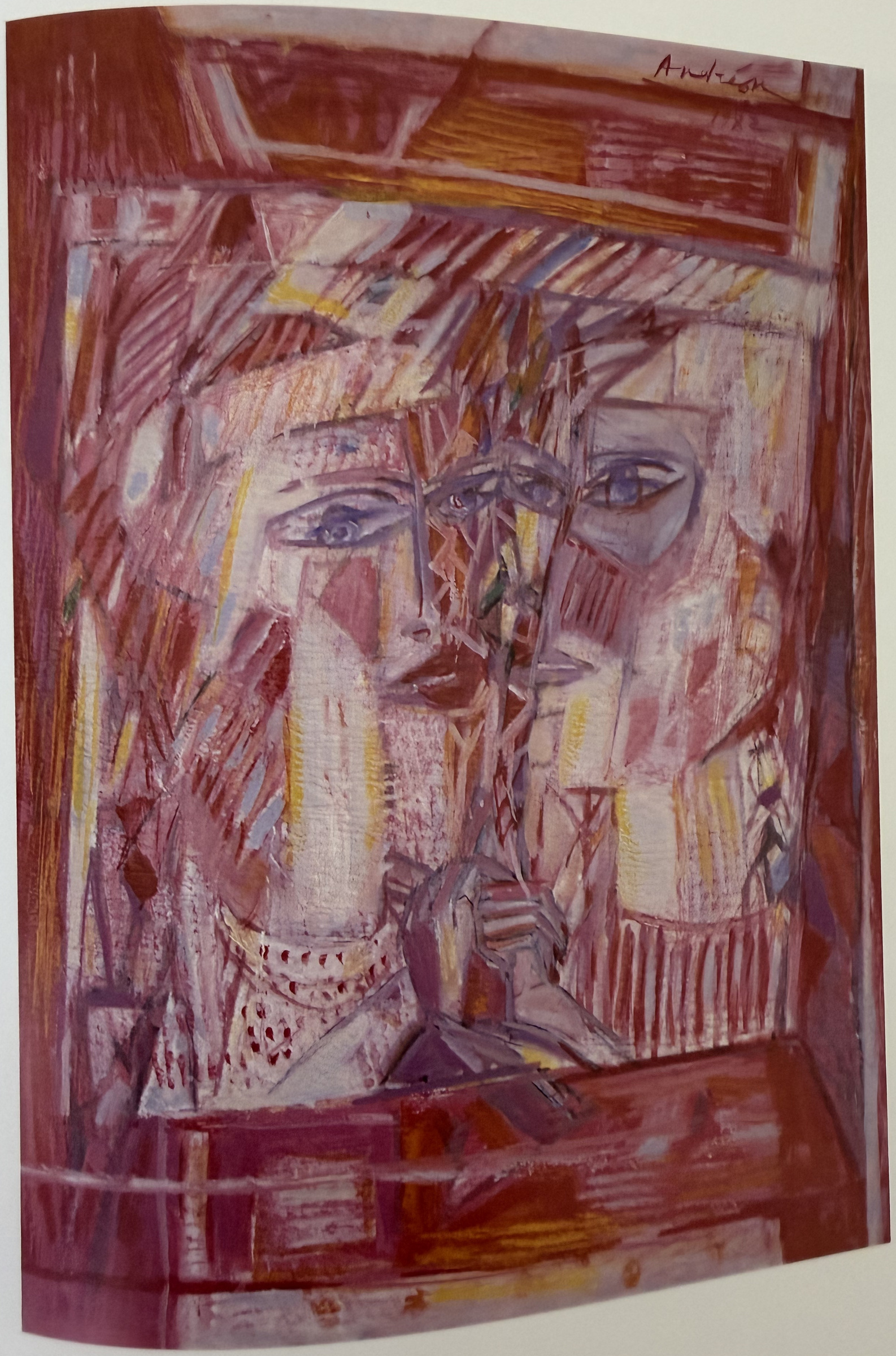
Rose, red, and violet surround the elongated faces in Les amoureux (1982). Prominent eyes sit near the centre, with thin yellow strokes crossing the pale cheeks. Broad bands above and below the faces form an inner frame; shorter diagonals cut across the space between them.
A kiss in red
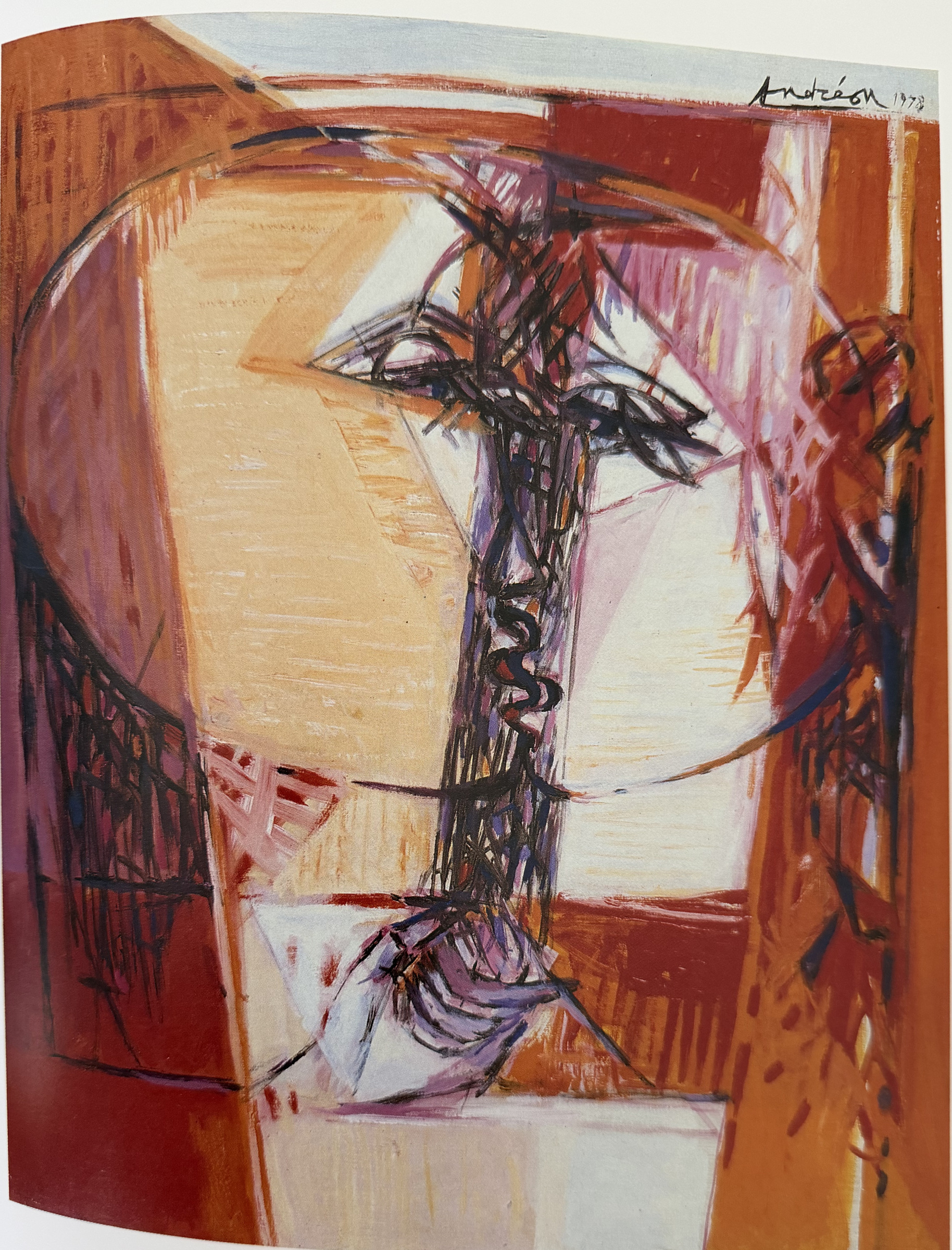
In Baiser rouge (1978), the left profile is yellow-orange and the right one cream. Dark marks separate the broad cheeks and outline the noses and mouths. A long curve sweeps around both heads, cutting across the angular red and orange areas around them.
Kazazi describes continuous circular movement in the kiss paintings and suggests that an oval enclosing two figures may evoke the cycle of life, love, and death. The enclosing curve in Baiser rouge can be read in those terms, as a boundary that holds the faces together.
Faces at different heights
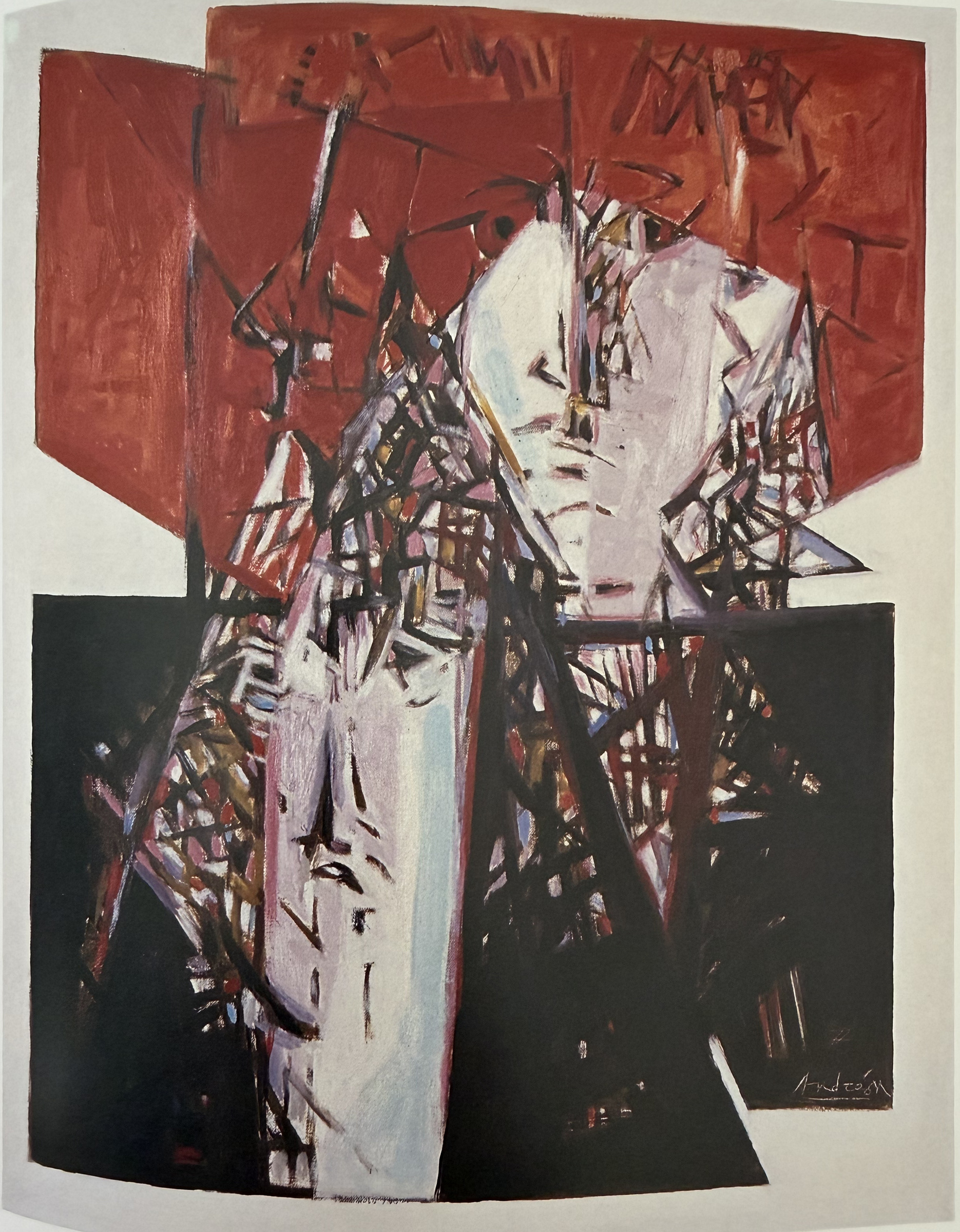
A long pale face extends down the left side of Couple (1977), below the cluster of features in its upper half. Red fills the upper field and black much of the lower part. White, violet, and ochre facets interrupt the dark lines between the faces, linking them to the angular shapes around them.
The last kiss
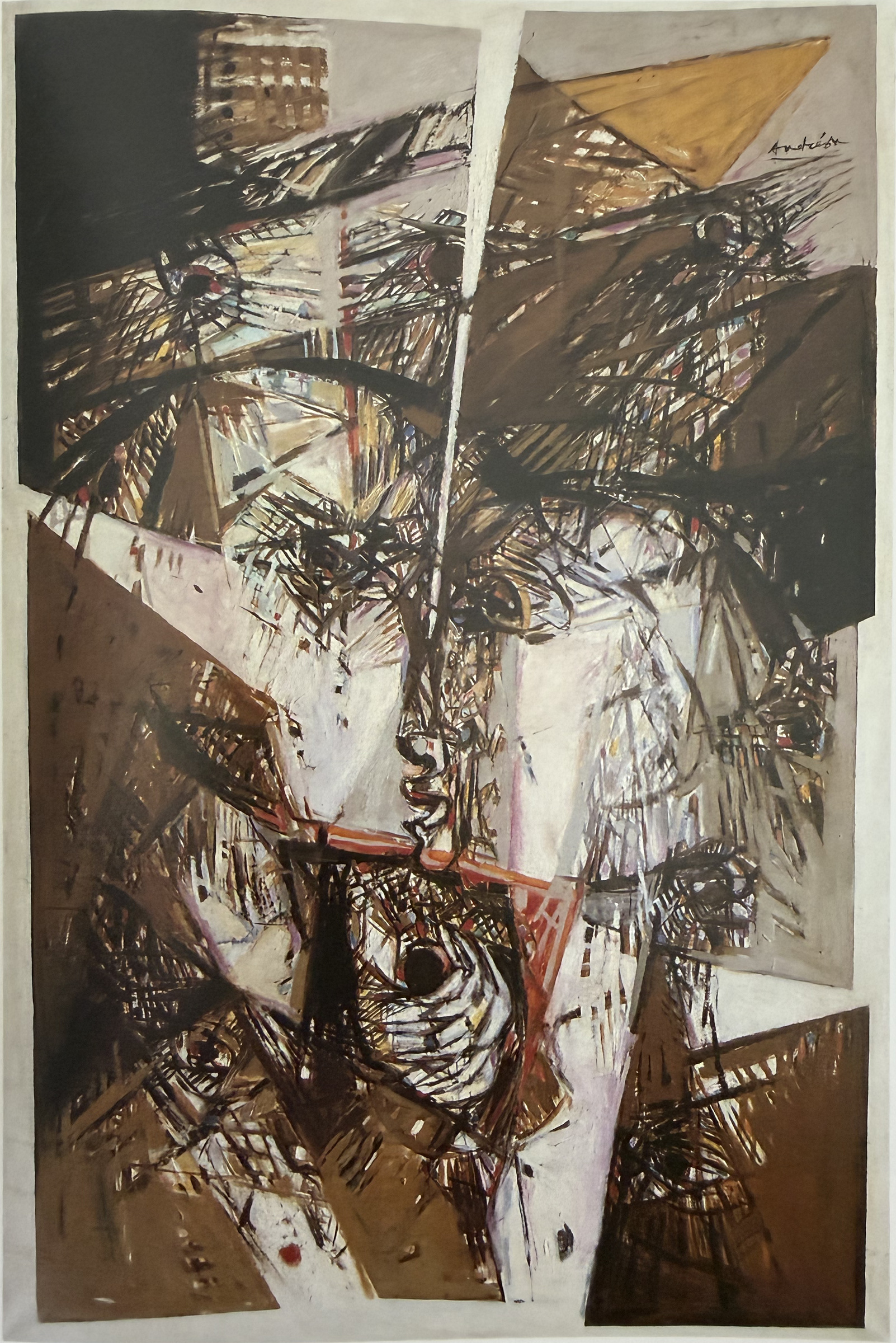
In Le dernier baiser (1978), pale profiles meet below the centre of a brown, black, and cream composition. Above them, slanting planes cut across dense strokes. A narrow pale wedge descends from the top edge towards the faces.
The title suggests a final encounter, without identifying a particular story. Kazazi’s question about protection and farewell concerns the wider theme; it does not document the circumstances of this painting.
In his statement in the same book, Andreou describes creation as an act of love and an attempt to discover an inner world. Overlapping faces and contours recur in Women and mirrors, where a woman and her reflection can become difficult to separate.
Sources and further reading
1. Sophia Kazazi, “Le baiser”, signed “Sophie Kazazi”, in Andreou. Femme · Femmes: Peintures (Édition G. Giannoussis, 1997), unpaginated. The quotation is translated from the French. The 1973 starting date is Kazazi’s chronology of the theme. Her comparisons with other painters describe Andreou’s distinctive approach; they do not establish direct influences. The readings of tragic intimacy, protection, enclosure, and the cycle of life, love, and death are hers. The application of her tentative oval interpretation to Baiser rouge is the Archive’s reading of the reproduction.
2. Constantine Andreou, signed artist’s statement beginning “Depuis mon enfance…”, in the same volume. The closing discussion follows his account of creation as an act of love and an exploration of an inner world.
3. Artwork titles and dates follow the catalogue records and corresponding reproductions in Femme · Femmes: Peintures. The close descriptions of individual paintings are the Archive’s observations of those reproductions.