
A mouth opens in a face made of pierced and ribbed metal. In Homme détruit (1975), Constantine Andreou sets a comparatively smooth outer shell around a crowded arrangement of strips, holes, and irregular edges. A diagonal bar crosses the centre. The features remain recognisable, but the surface that would ordinarily hold them together is interrupted by openings.
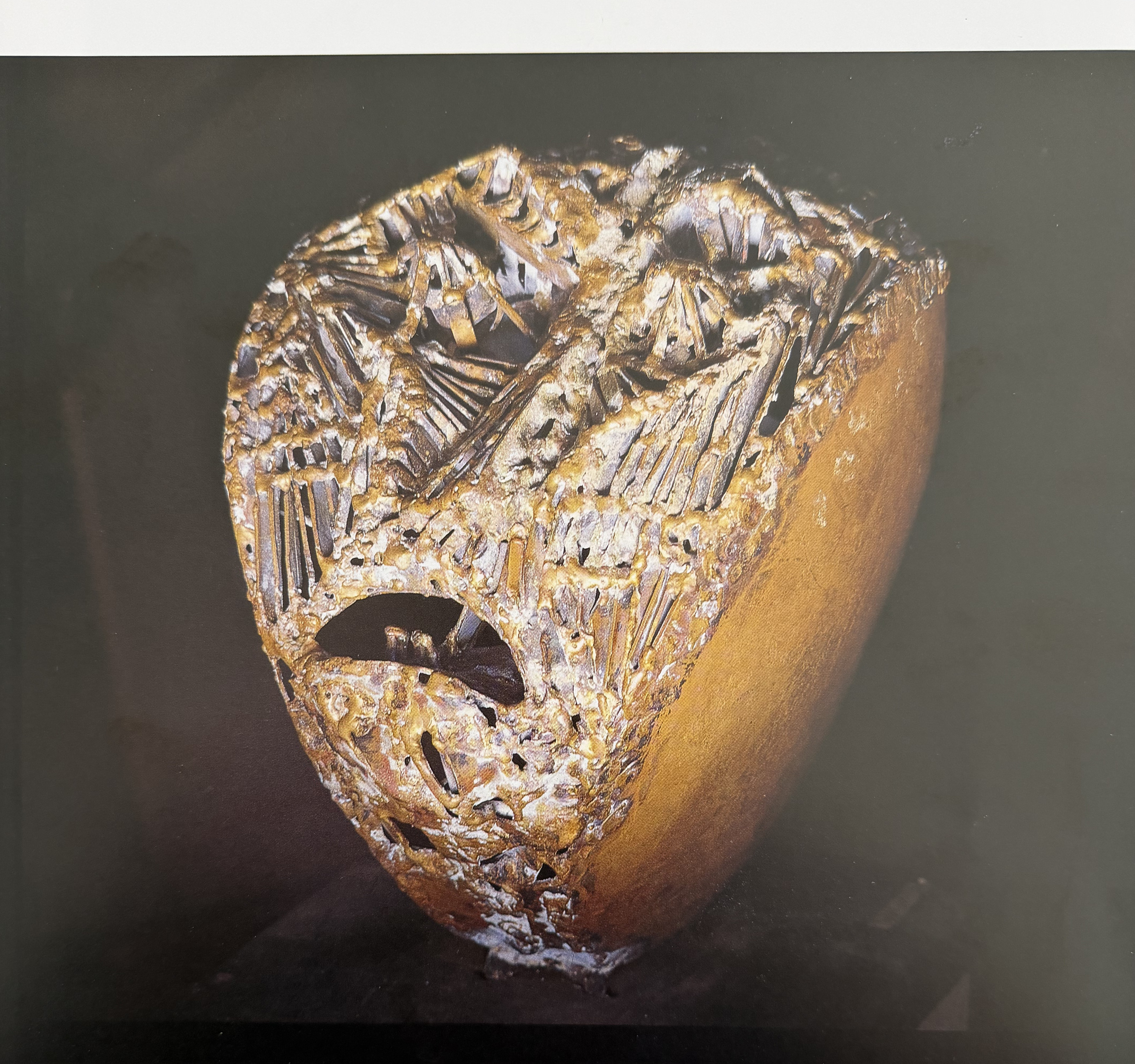
The title, meaning “destroyed man”, gives these openings a human significance. Sapfo A. Mortaki reads Andreou’s distorted heads as expressions of suffering and resistance to oppression. She draws attention to the contrast between smooth metal surfaces and the fragments visible within them.1
An interrupted face
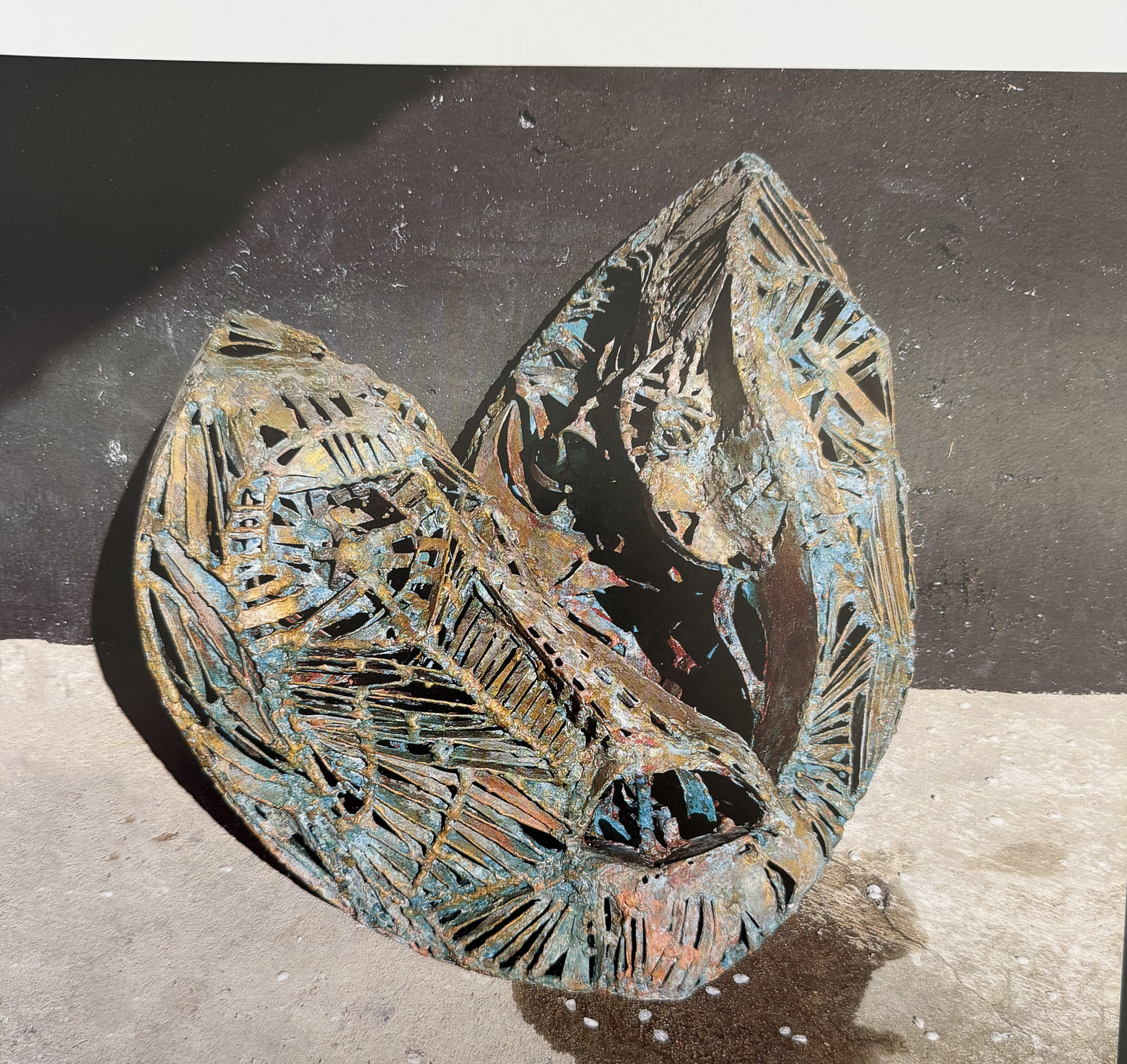
In a second sculpture titled Homme détruit, also dated 1975, a deep gap interrupts the upper contour. Thin metal strips spread across the remaining surfaces in changing directions. An eye and an open mouth emerge among the slits, while a broad dark space occupies much of the centre. The outline allows us to recognise a head before we have made sense of its scattered features.
Figures behind bars
Confinement also enters Andreou’s painting. In her account of his paintings of human suffering, Mortaki describes figures gripping bars, gaunt faces, and dense dark marks cut by light. She connects these images with protest against injustice and with memories of the occupation of Greece and wartime violence.2
The dissertation’s illustration volume also includes Η Φυλακή / La Prison (1974), the third illustration on p. 165, item 159. Red lines crowd the pale ground, enclosing faces within an uneven grid. The marks that describe the figures also run across them, making it difficult to separate a body from its enclosure.

Andreou spoke about such subjects in a response to Sophia Kazazi in 1986, reproduced by Mortaki. He described expressing the things that caused suffering on canvas or in metal and linked the intensity of his lines and dark colours to the injustices of his own time.2
For other approaches to the sculpted face and its interior, see Eyes and inner worlds.
Sources
1. Sapfo A. Mortaki, Η καλλιτεχνική μετανάστευση στην Ελλάδα: από τον 19ο στον 20ό αιώνα (1870–1970): η περίπτωση του Κωνσταντίνου Ανδρέου, doctoral dissertation, Aristotle University of Thessaloniki, 2010, main volume, p. 327, especially nn. 346–347 and 351–352.

2. Mortaki, same dissertation, main volume, pp. 340–341. On p. 341, n. 467 refers to Kazazi’s 1992 retrospective catalogue, p. 10; n. 468 cites Kazazi, 1986, for the artist’s response. The painting’s title and date follow the caption in the illustration volume, p. 165, item 159.


The two sculpture titles and dates follow the inspected captions in ANDREOU / ΓΛΥΠΤΙΚΗ / SCULPTURE: BAS-RELIEFS EN COULEURS (Athens: Bastas Editions, 1999), pp. 58–59. The medium follows the volume’s Greek and French technical note. Library record for the volume. Present collection statements follow the linked Archive records. Descriptions of the illustrations are the Archive’s observations of the reproductions.