
In Constantine Andreou’s mirror paintings, a face or an arm can be clearly drawn while the rest of the figure breaks into overlapping marks. These five works, dated from 1974 to 1997, vary from the broad orange forms of Miroir rouge to the much denser drawing of Miroir bleu.
Sophia Kazazi opens her essay “Femme et Miroir”, published in Femme · Femmes: Peintures (1997), with a distinction:
The mirror is not merely a doubling of the image.
Sophia Kazazi, “Femme et Miroir”, in Femme · Femmes: Peintures (1997). Translated from the French.
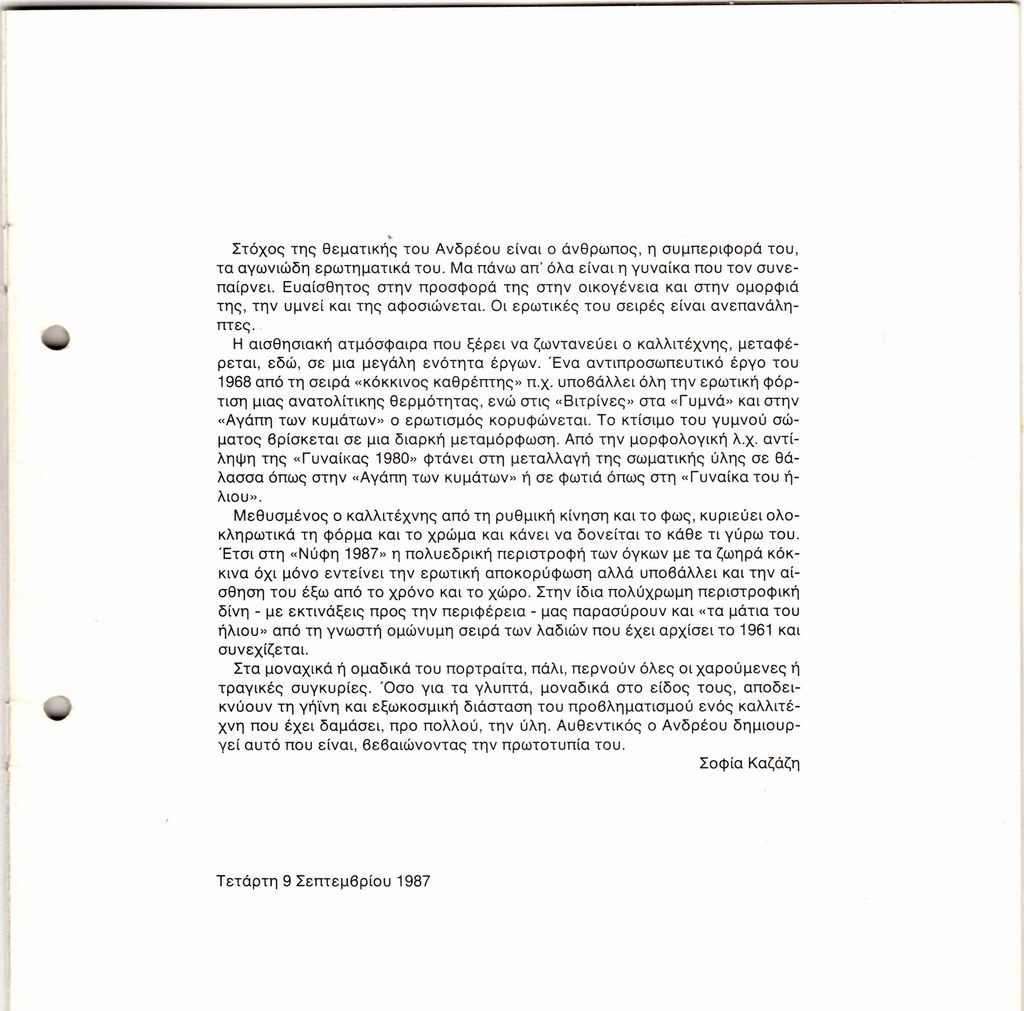
Writing for Andreou’s 1987 exhibition at Antinor in Athens, Kazazi had already described the nude body as undergoing continual transformation, becoming sea or fire. She also drew attention to rhythm, light, and the artist’s command of form and colour.2
Inside the red border
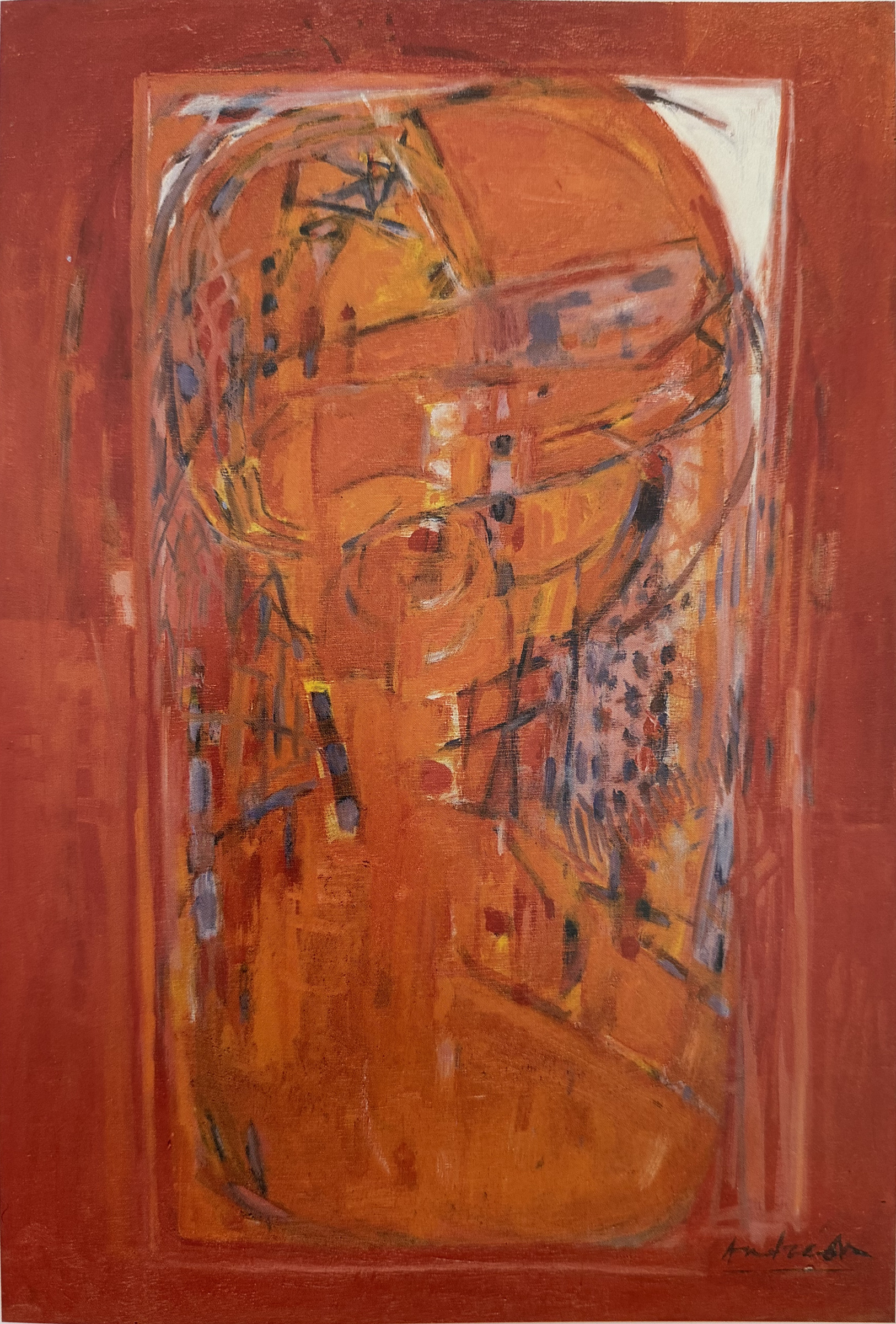
In Miroir rouge (1974), a broad red border encloses an orange field. Dark curves run around the head and torso, while bands of colour cross the upper body at an angle. Small blue-grey and dark marks collect along the sides, leaving larger areas of orange open.
The red rectangle gives the painting a frame of its own. Within it, rounded bodily forms overlap; their outlines do not neatly divide a woman from her reflection.
Kazazi compares Andreou’s paintings with depictions of a woman holding a mirror, or of a mirror placed within a scene. In her reading of his work, woman and mirror form a single pictorial whole. Dense drawing joins them to the space around them.
Two faces
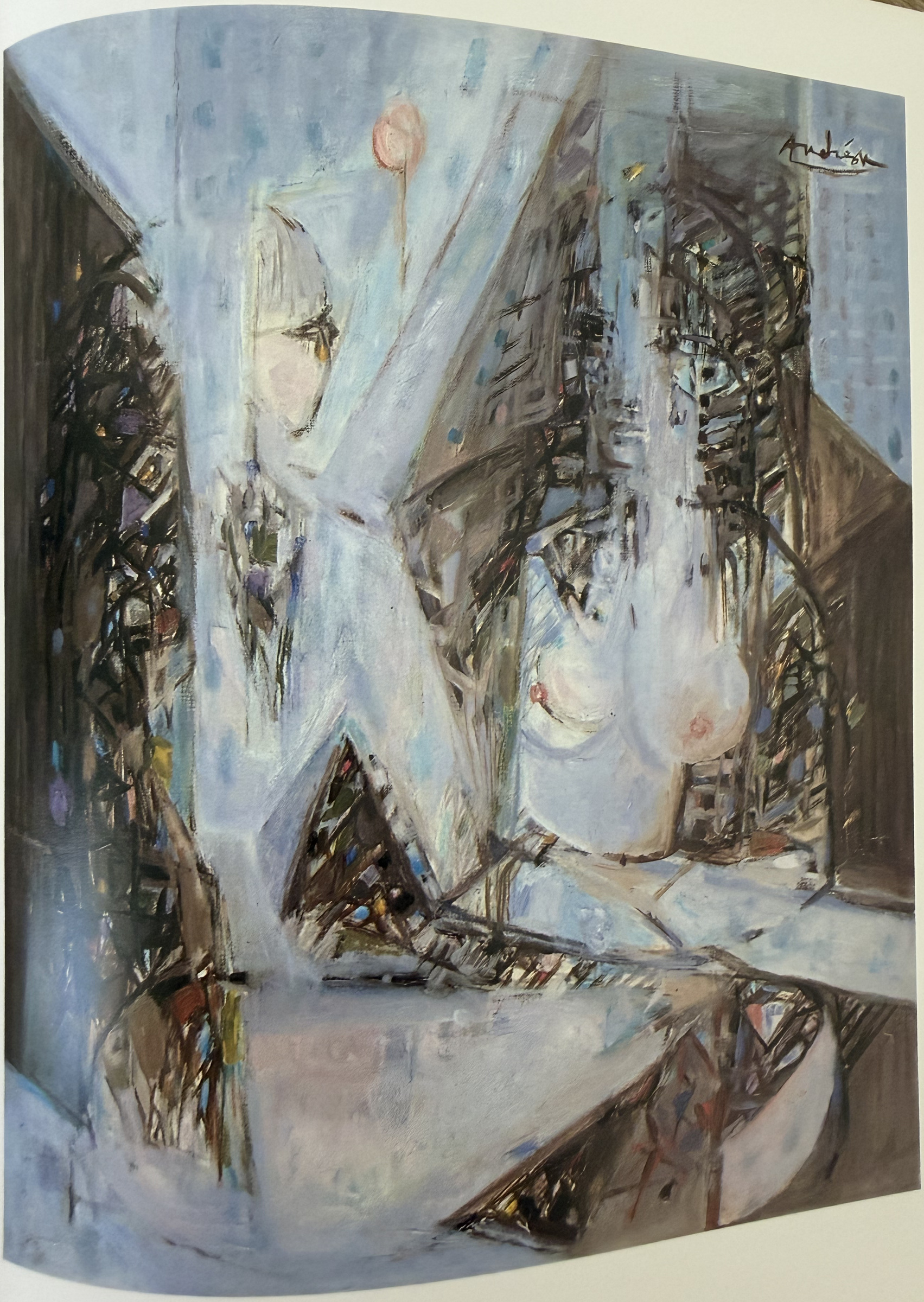
A pale face appears on each side of Femme au miroir (1978–79). Large blue-grey shapes cross the centre, with tightly packed dark marks along their edges. The left profile is picked out by a few thin lines, while the other face is harder to distinguish from the darker drawing around it.
Kazazi also reads the mirror as a reminder of passing time. In her account, a woman looks for confirmation of her beauty and youth while fearing their loss.
Across the yellow bands
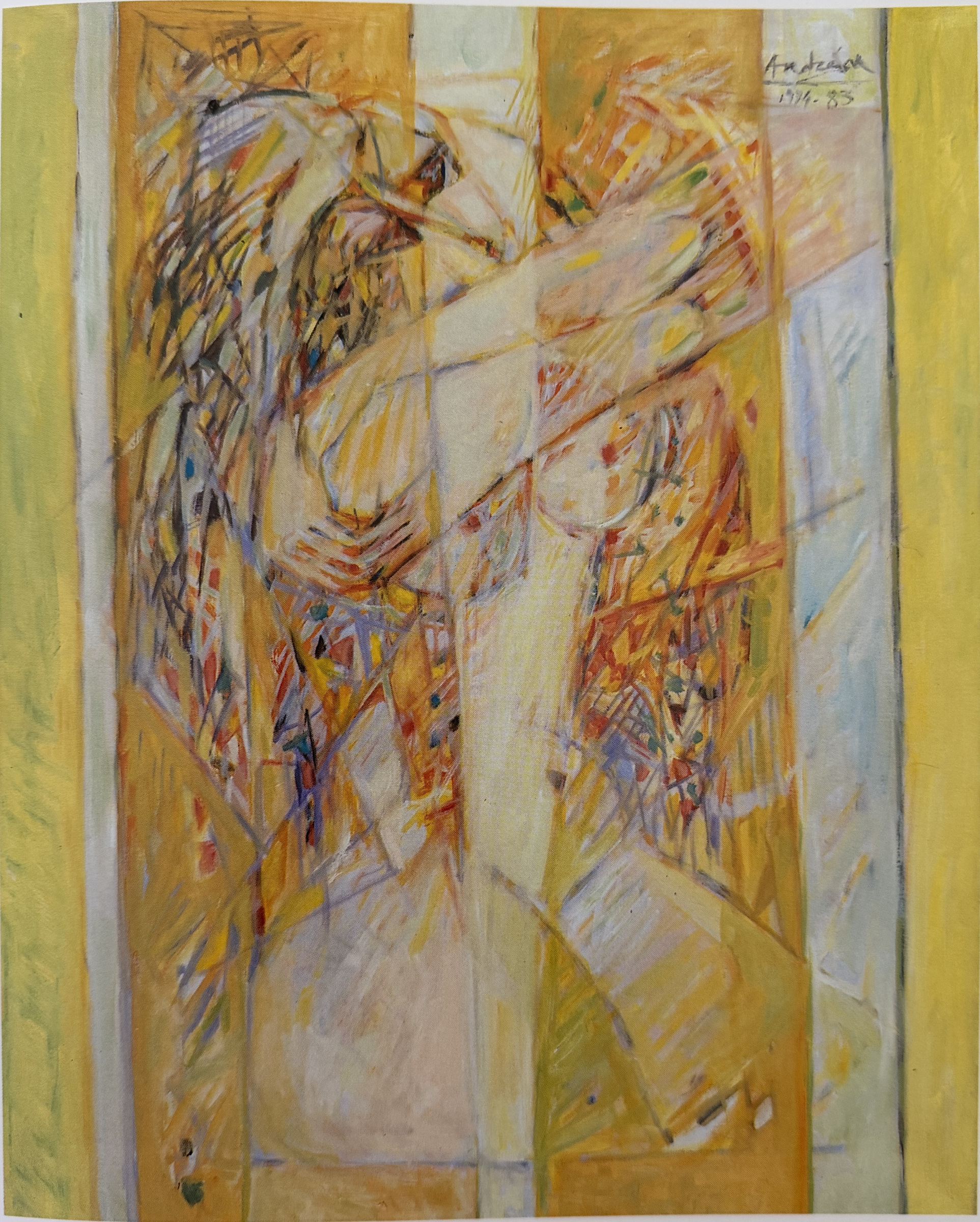
Yellow fills most of Miroir jaune (1983). A pale arm crosses the upright bands at an angle, surrounded by short strokes of red, blue, and violet. These small marks continue across the torso and the space beside it, interrupting the figure’s outline.
In her essay, Kazazi describes a Miroir jaune built from successive vertical zones of colour and light. In the painting illustrated here, the upright bands are clearly visible beneath the shorter, slanting strokes.
Within an oval
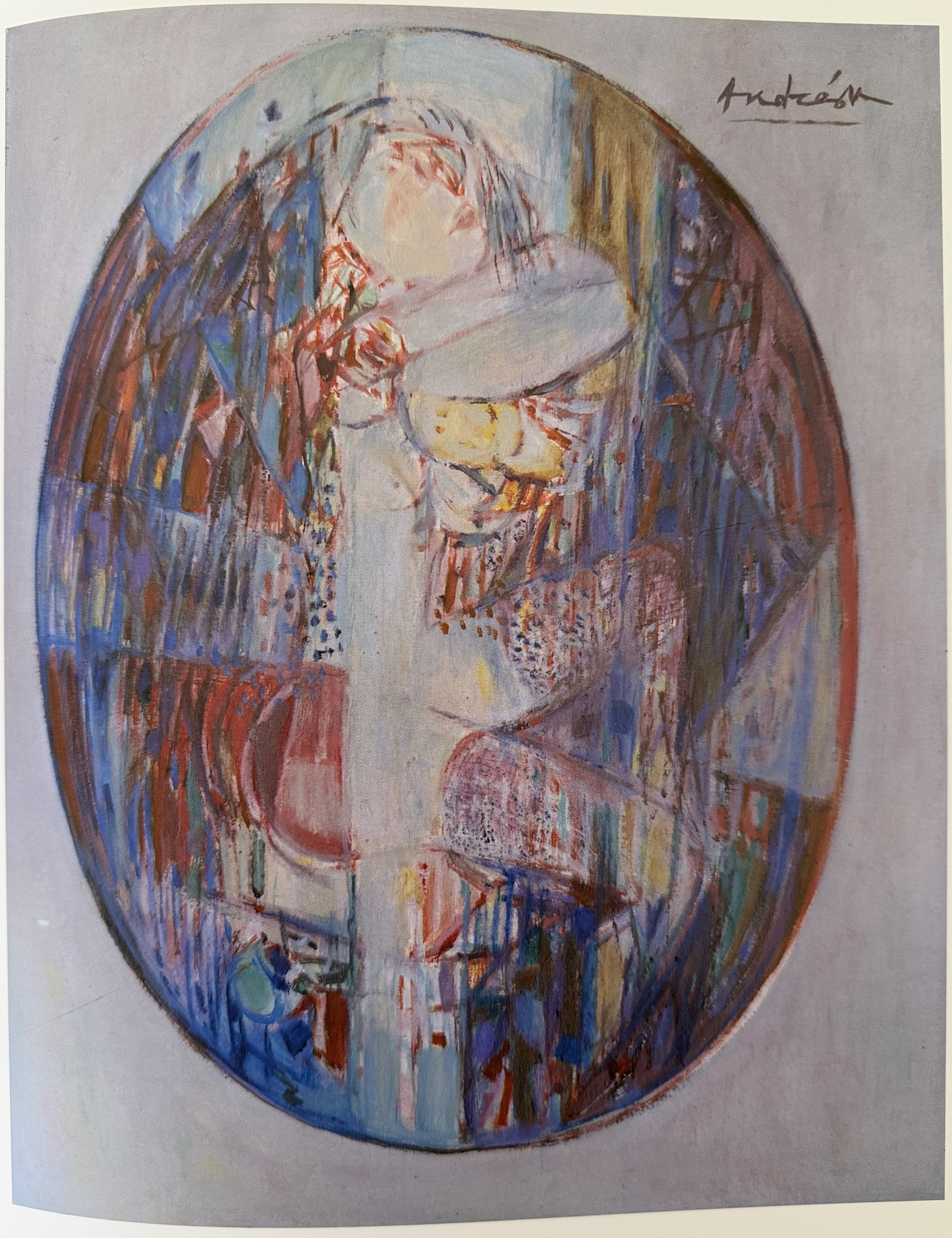
A wide, pale arm folds across the upper body in Miroir ovale (1989). The figure occupies the centre of a large oval, with blue, rose, and brown marks filling much of the space on either side. Long strokes follow the curve at the left edge; more angular passages break up the right.
Against the pale ground, the oval’s edge is easy to follow from top to bottom. Its curve contrasts with the straight red border of Miroir rouge, though both enclose bodies whose internal divisions are harder to trace.
Broken contours in blue
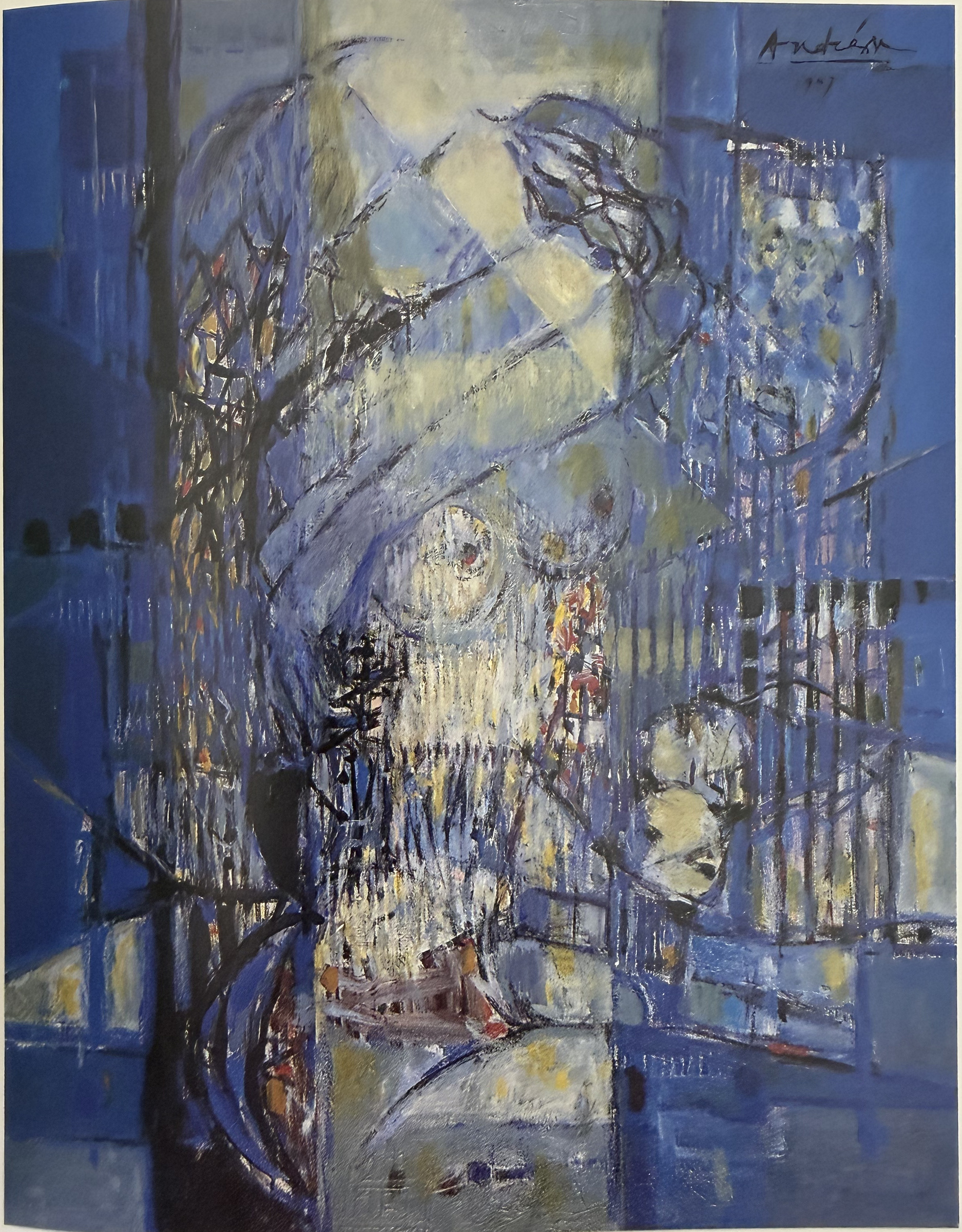
Miroir bleu (1997) has a dense centre and more open stretches of deep blue near the edges. Pale arms angle across the upper half; below them, parts of the torso remain visible among short dark and light strokes. Its contours become harder to follow where these strokes accumulate.
Andreou uses the mirror as a metaphor in his own statement in Femme · Femmes. He writes of passing through it to move beyond an idealised female image with perfect curves and to recompose his own perception of femininity in paint. The passage goes on to describe forms becoming colour, graphic marks carrying meaning, and light recreated from within.
That close connection between a body and its setting also appears in Amour des vagues, where the curve of a shoulder or hip continues into the surrounding water.
Sources
1. Sophia Kazazi, “Femme et Miroir”, signed “Sophie Kazazi”, in Andreou. Femme · Femmes: Peintures (Édition G. Giannoussis, 1997), unpaginated. The quotation is translated from the French. The discussion of time, beauty, youth, and the integration of woman, mirror, and surrounding space follows her essay. Her references to titled mirror paintings do not, by themselves, identify particular dates or catalogue records. BnF catalogue record.
2. Sophia Kazazi, Εισαγωγή στο έργο του Ανδρέου [Introduction to Andreou’s work], in Andreou (Athens: Antinor, 1987), unpaginated two-page essay dated 9 September 1987; second page of the essay. Tony Spiteris Archive, Teloglion Foundation of Arts, Aristotle University of Thessaloniki. Her discussion concerns Andreou’s painting more broadly.
3. Constantine Andreou, signed artist’s statement beginning “Depuis mon enfance…”, in Andreou. Femme · Femmes: Peintures (1997). The discussion of passing through the mirror, moving beyond an idealised figure, and transforming form, graphic marks, colour, and light follows his French text and expresses his stated aims.
4. Artwork titles and dates follow the catalogue records and the corresponding reproductions in Femme · Femmes: Peintures. Titles and years alone do not establish the identity of an individual work. The close descriptions and comparisons of the illustrated paintings are the Archive’s observations of those reproductions.