
Closely gathered heads recur in Constantine Andreou’s paintings titled Famille. Below the faces, bodies overlap or break into angular sections, and their outlines can be hard to follow. The five works here range from pale, relatively open groups to dense arrangements of blue, red, and black.
In her introduction to Femme · Femmes: Peintures (1997), Sophia Kazazi places the family among Andreou’s central themes, alongside hope and the couple. She writes of a painter concerned with human life and its anxieties, with joy, sorrow, and the prospect of death.
In the book’s essay “Univers féminin – Famille”, she describes figures merging with their surroundings. Her account starts at the joined heads and follows colour and line out into the background:
Thus, the image is transformed through a circular, repetitive movement.
Sophia Kazazi, “Univers féminin – Famille”, in Femme · Femmes: Peintures (1997). Translated from the French.
A group held together
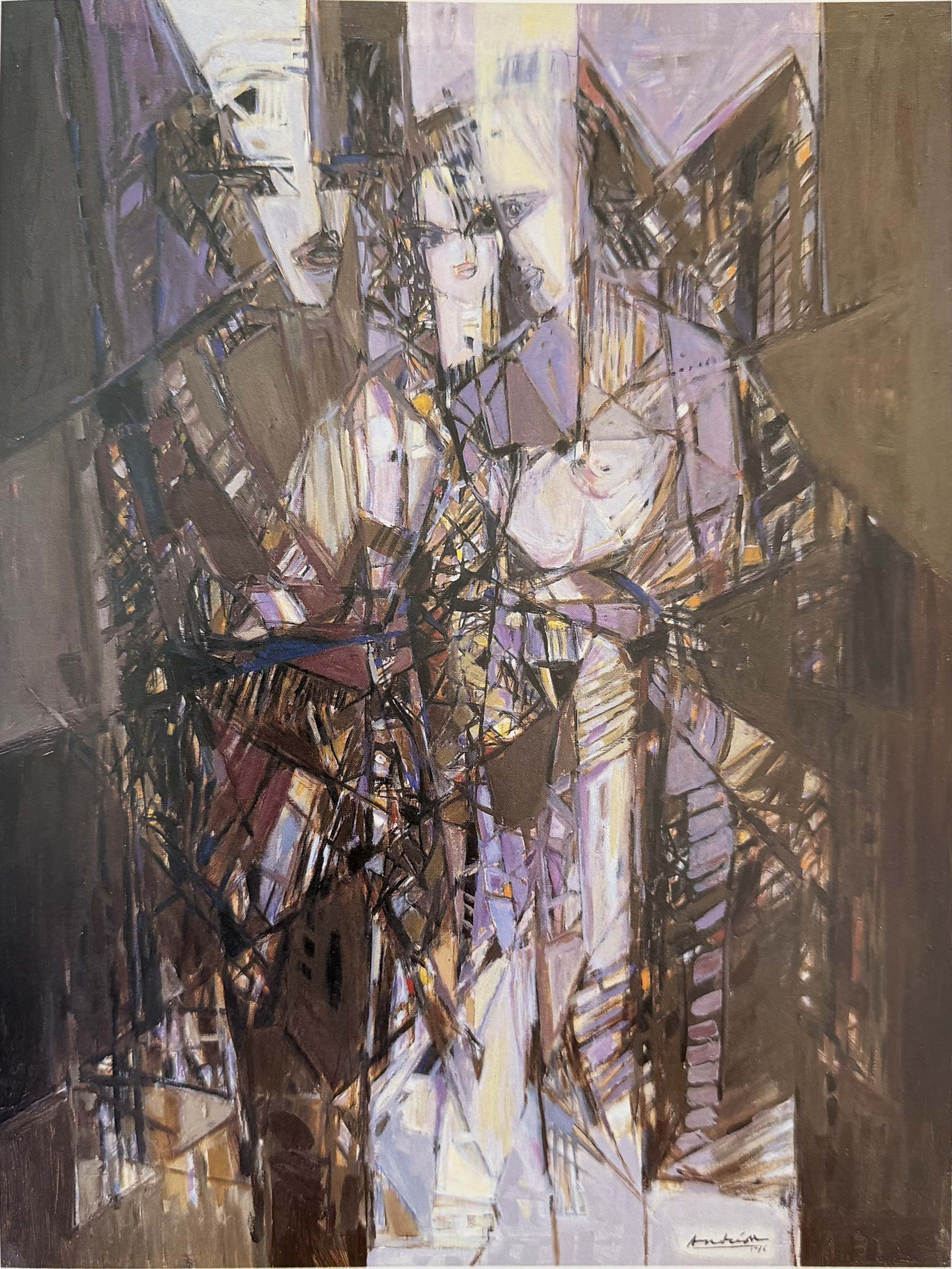
In Famille (1976), a small pale face sits between two elongated heads near the top of a tall composition. Below them, the bodies are difficult to separate within a dense pattern of brown, mauve, black, and cream. Pale vertical shapes are crossed by dark diagonals.
In a 2016 study, Sapfo Mortaki reads this painting’s repeated tones, interwoven drawing, and closely gathered heads as expressions of family unity.
Two arrangements
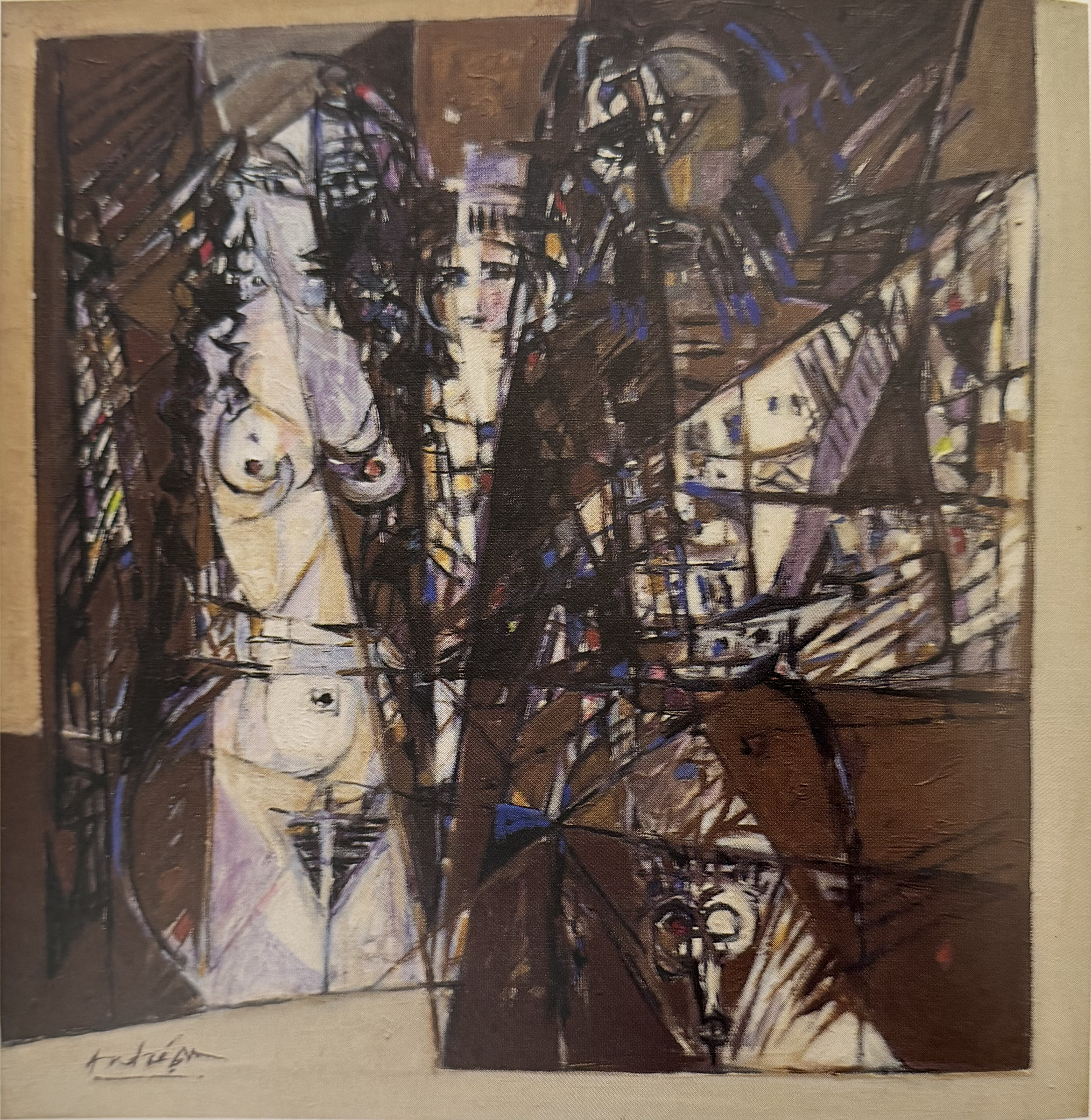
Famille (1978) spreads the group across a broader field. A pale figure occupies the left, a smaller face appears near the centre, and a darker head rises towards the upper right. Large brown planes, crossed by diagonal bands and patches of violet, occupy much of the surface.
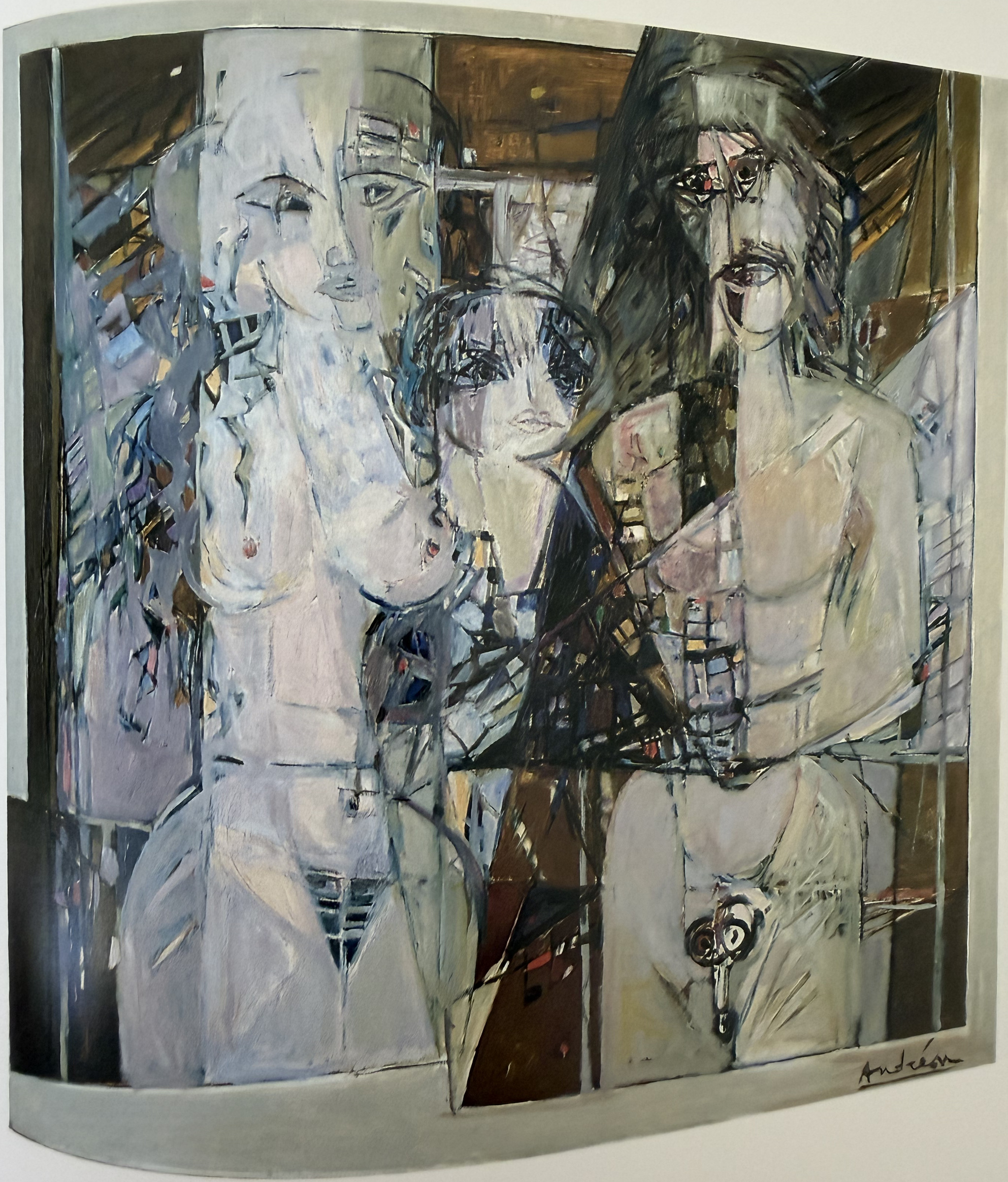
In Famille (1980), the bodies are easier to distinguish. Two tall, pale figures flank a smaller face, and large eyes dominate the upper half. Cream, grey, and muted violet lighten the surface, interrupted by narrow brown and black bands.
Mortaki discusses these two paintings together, linking their nude bodies with fertility, birth, and creation.
A family in blue
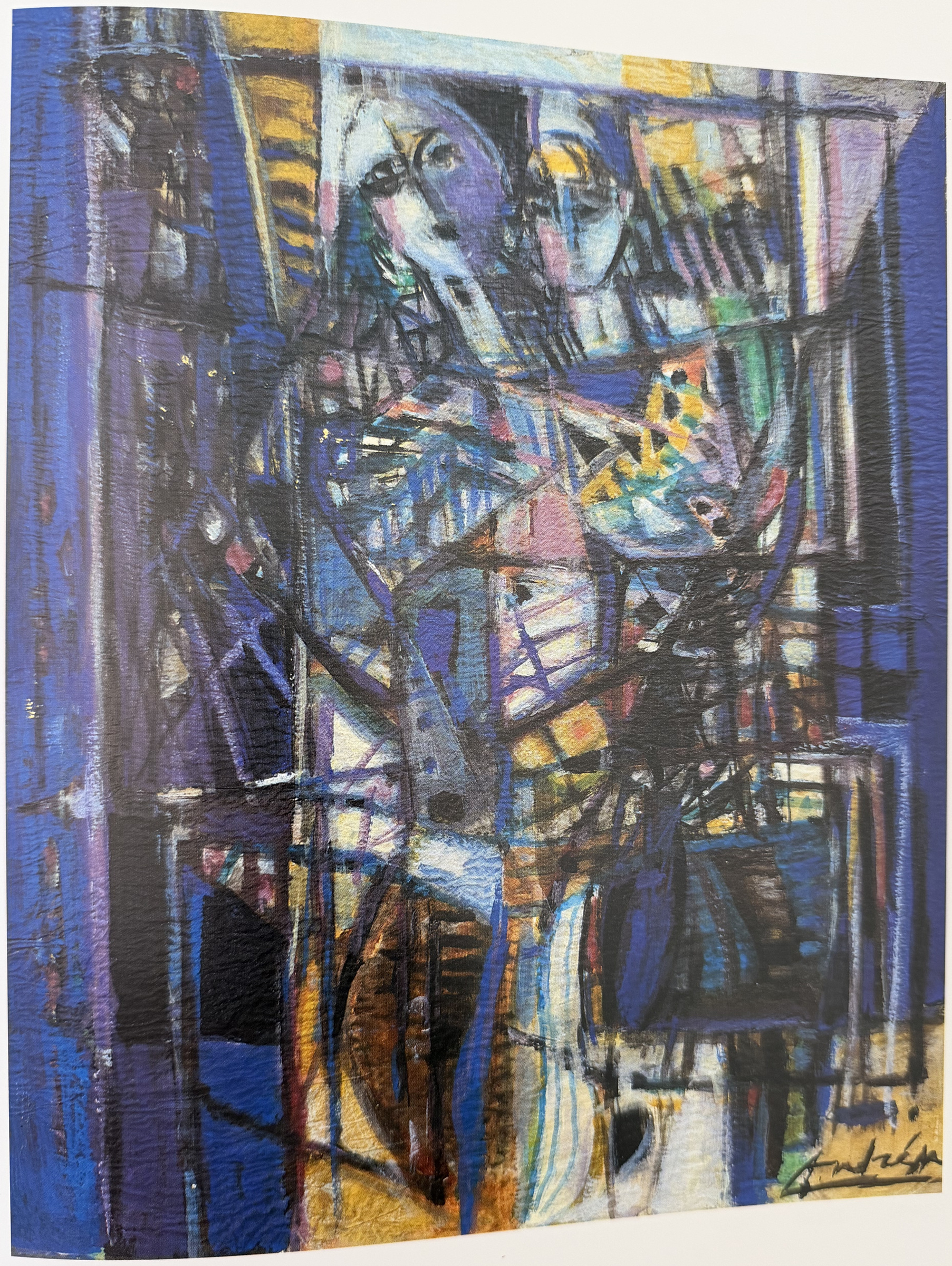
Famille (1979) is framed by broad blue vertical bands. Between them, pale faces sit above a mass of yellow, pink, and green fragments. Curving outlines cut across dark bars and angular shapes.
Blue passes through the figures and the space around them. This continuity of colour recalls Andreou’s statement in the 1997 book, where he describes his search for harmony among graphic marks, drawing, colour, and light.
Famille brésilienne
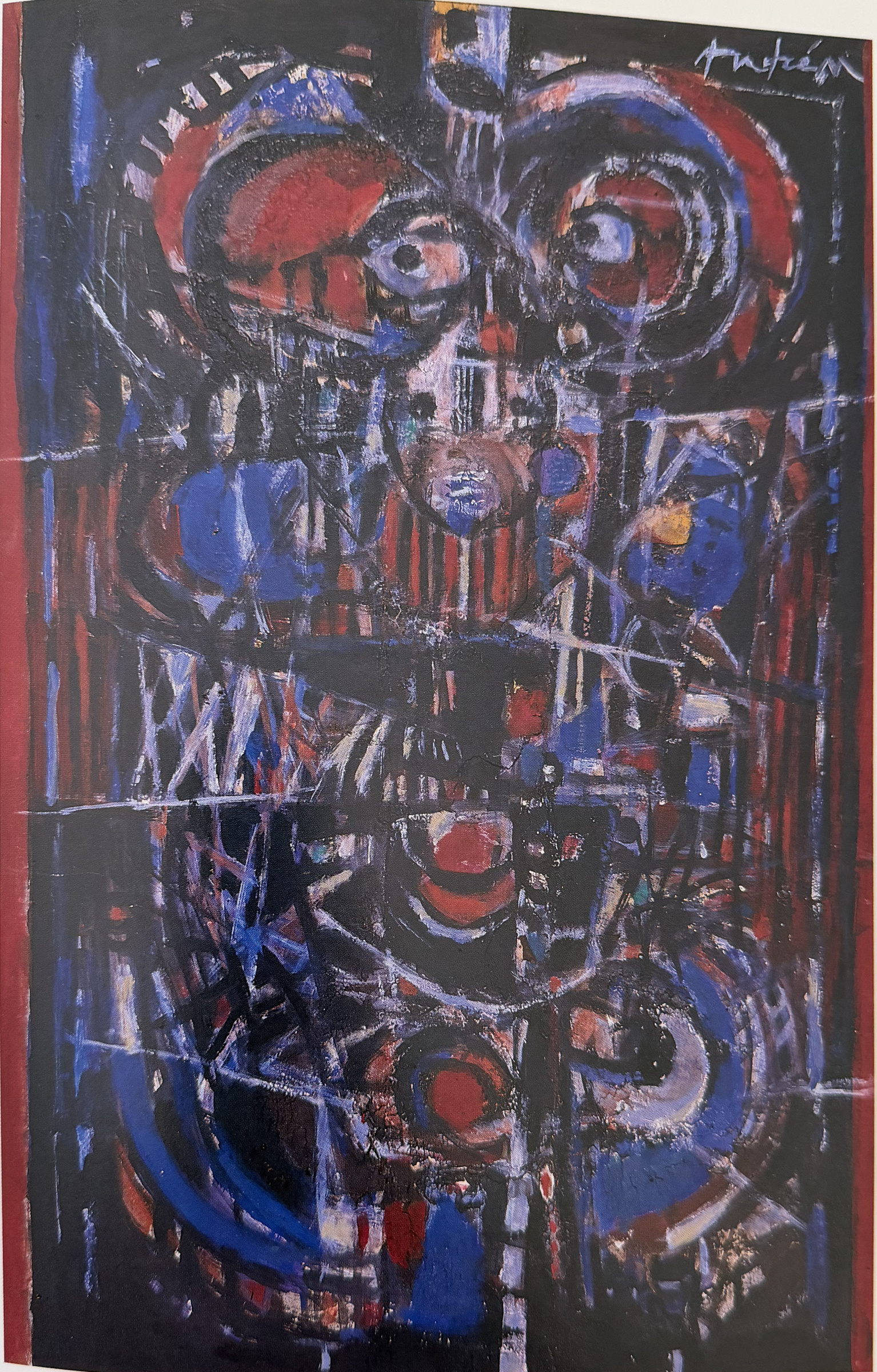
Famille brésilienne (1994) is much darker. Red and blue curves surround the large eyes near the top, while smaller rounded shapes run down the centre. Black fills much of the space between them, broken by violet and pale strokes.
Mortaki finds a musical quality in the work, relating its repeated lines and changing colours to rhythm and musical notation. Red curves and blue patches recur down the length of the painting, interrupted by clusters of short, pale marks.
Related paintings appear in The kiss and the couple, which follows Andreou’s treatment of two figures, often joined along a shared outline.
Sources and further reading
1. Sophia Kazazi, “L’érotisme dans l’oeuvre peinte d’Andréou” and “Univers féminin – Famille”, signed “Sophie Kazazi”, in Andreou. Femme · Femmes: Peintures (Édition G. Giannoussis, 1997), unpaginated. The introduction places the family among Andreou’s recurring human concerns; the thematic essay discusses figures, background, and circular movement. The quotation is translated from the French.
2. Sapfo Mortaki, “Family and Maternity Perceived and Pictured by a Migrant Artist: Paintings of Constantine Andreou”, Journal of Research in Gender Studies 6(1) (2016), pp. 121–144, especially pp. 129–136, figs. 4, 6–7, 9–10, which reproduce these five paintings. DOI: 10.22381/JRGS6120163. Her critical interpretations are attributed in the text.
3. Constantine Andreou, signed artist’s statement beginning “Depuis mon enfance…”, in Femme · Femmes: Peintures (1997). The discussion of graphic marks, drawing, colour, and light follows his account of his painting practice.
4. Artwork titles and dates follow the catalogue records and corresponding reproductions in Femme · Femmes: Peintures. The close descriptions of individual paintings are the Archive’s observations of those reproductions, alongside the attributed critical readings above.