
In Oiseau vers le Ciel (1978), a long point rises above the bird’s spreading planes. The narrow lower body meets the base at a single slender support. Between these two ends, folded sheets and small grid openings give the figure an uneven, changing outline. The sculpture stands firmly on its plinth, yet its whole posture directs the eye upwards.
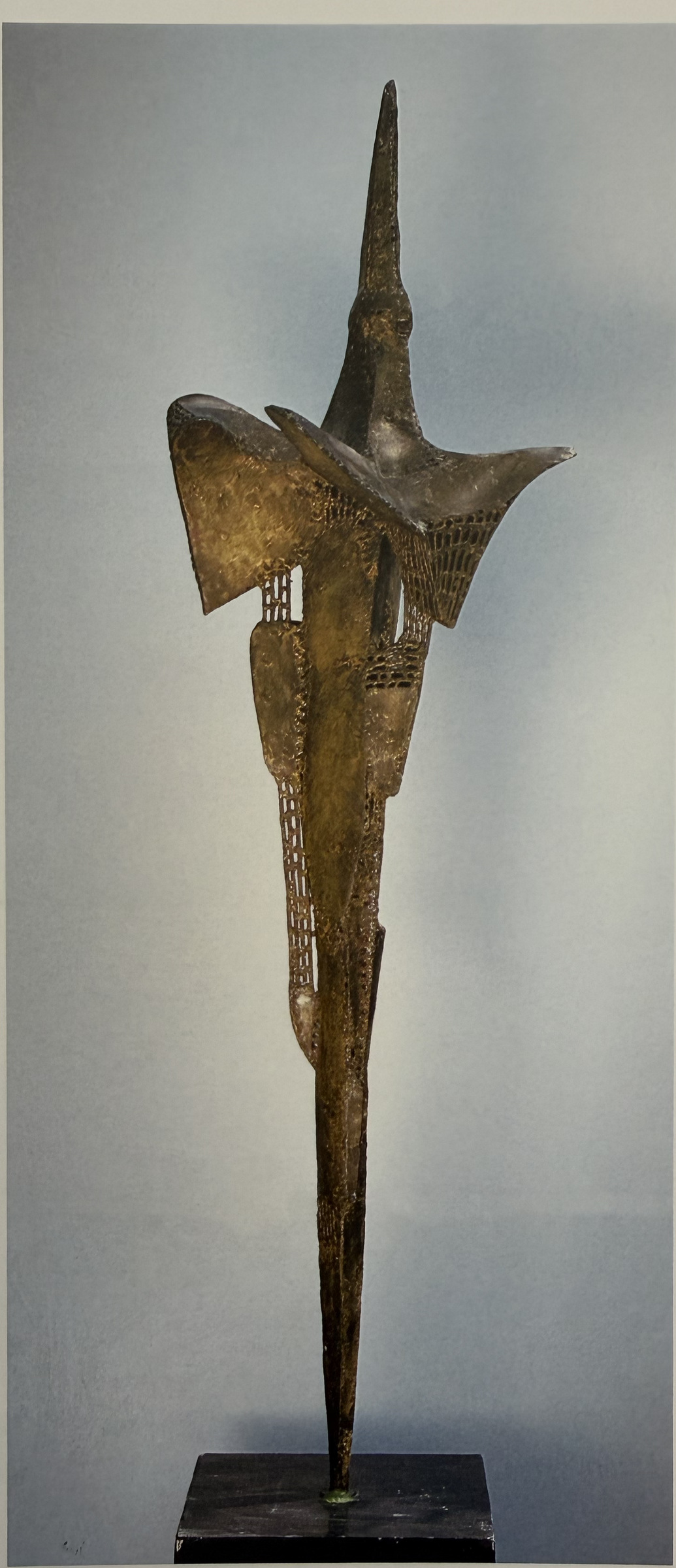
Birds recur throughout Andreou’s sculpture, carrying very different moods. In her study of his work, Sapfo A. Mortaki reads the wounded bird of 1954 as an image of vulnerability and stubborn resistance. In other birds, she sees a sense of freedom.1
The four works bring together an upward-reaching figure, a bird that does not fly, an open aerostatic construction, and a coloured relief.
A bird that does not fly
In Oiseau qui ne vole pas (1994), a sharp point at the right and projecting planes at the left extend the broad silhouette sideways. Folded surfaces rise and fall across the blue-green body, and a rectangular projection interrupts its upper edge. The narrow support underneath leaves much of the form clear of the base, making its balance conspicuous.
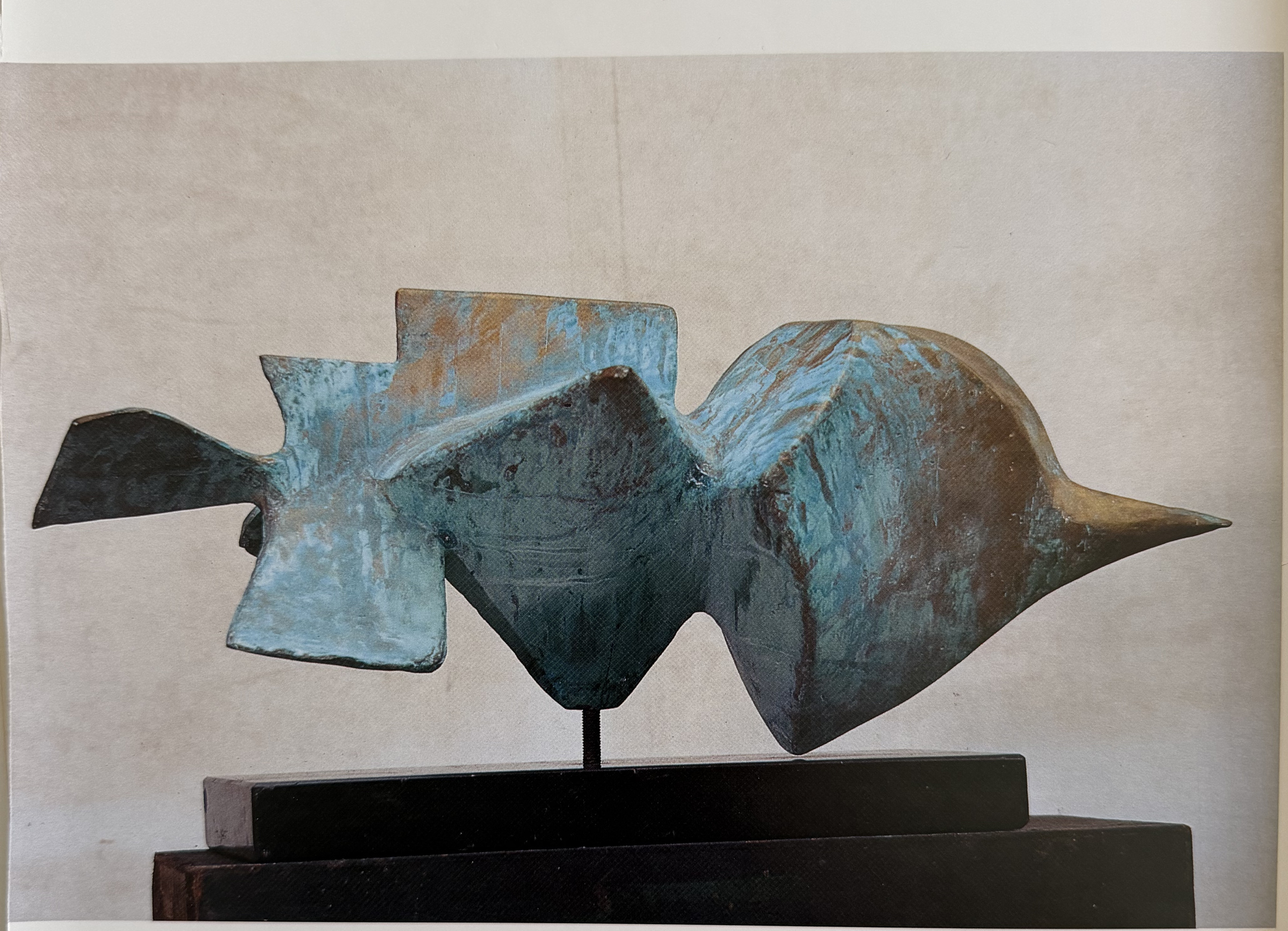
Beside the tall Oiseau vers le Ciel, this bird spreads out and occupies the space above its plinth. The contrast comes from the shapes themselves: one composition gathers force along a vertical axis; the other extends across a low, wide span. Flight remains a question of direction and balance even when the title withholds it.
Beyond wings
In Aérostatique (1968), thin rods extend far above and below the central structure. A small red surface holds the eye near the middle, while repeated bars, short crosspieces, and rounded tips draw attention outwards. Much of the object consists of intervals between these lines. The photograph’s dark background makes the open construction particularly easy to follow.
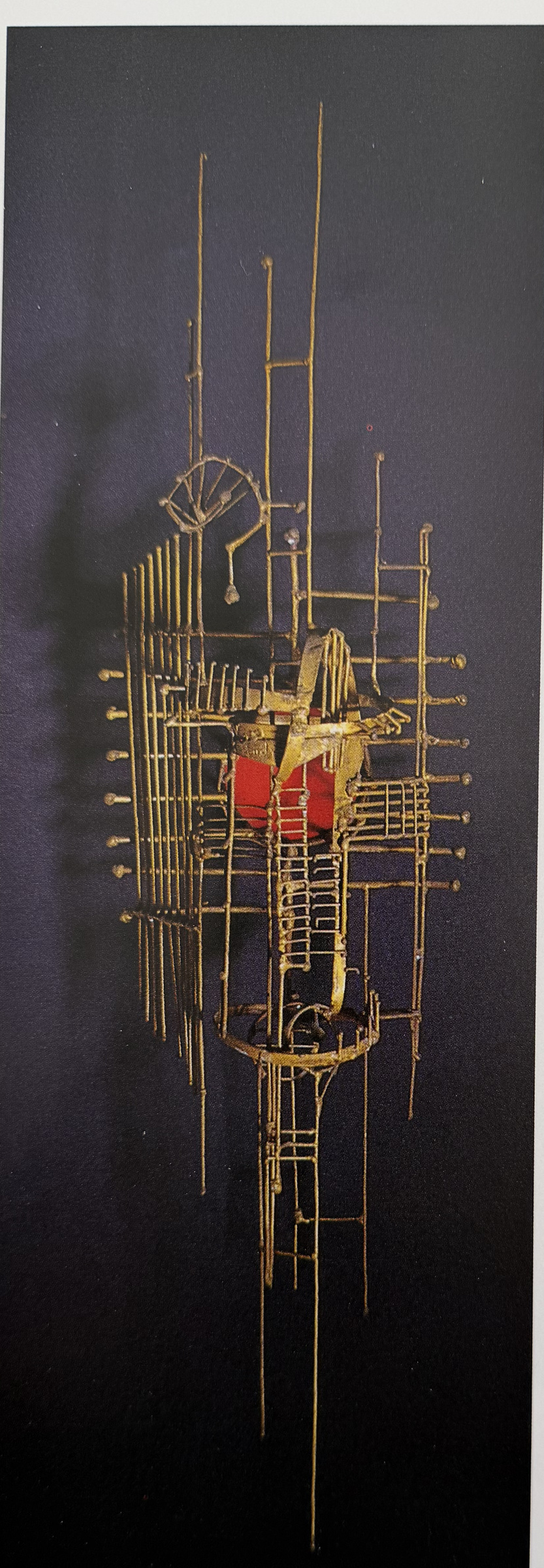
Mortaki connects Andreou’s increasingly fine linear constructions with his aerostatic subjects and the appearance of lightness. Her discussion of the aerostats emphasises the illusion of forms freed from weight. In the sculpture shown here, the title evokes buoyancy, while its exposed structure leaves the surrounding space visible.2
The theme also reaches into imagined spacecraft. Drawing on Michèle Dubreucq, Mortaki compares a spacecraft sculpture of 1973 to a great bird rushing into space and interprets it as an imagined escape from violence and the pressures of technological civilisation.2
Rhythm in relief
Symphonie d’oiseau (1963) brings the subject onto a rectangular relief. Curved forms overlap, ribbed strips change direction, and red accents punctuate the gold and dark surfaces. Some lines fan out; others gather into tight groups. The eye moves between broad areas and densely worked passages, finding a different pace in each.
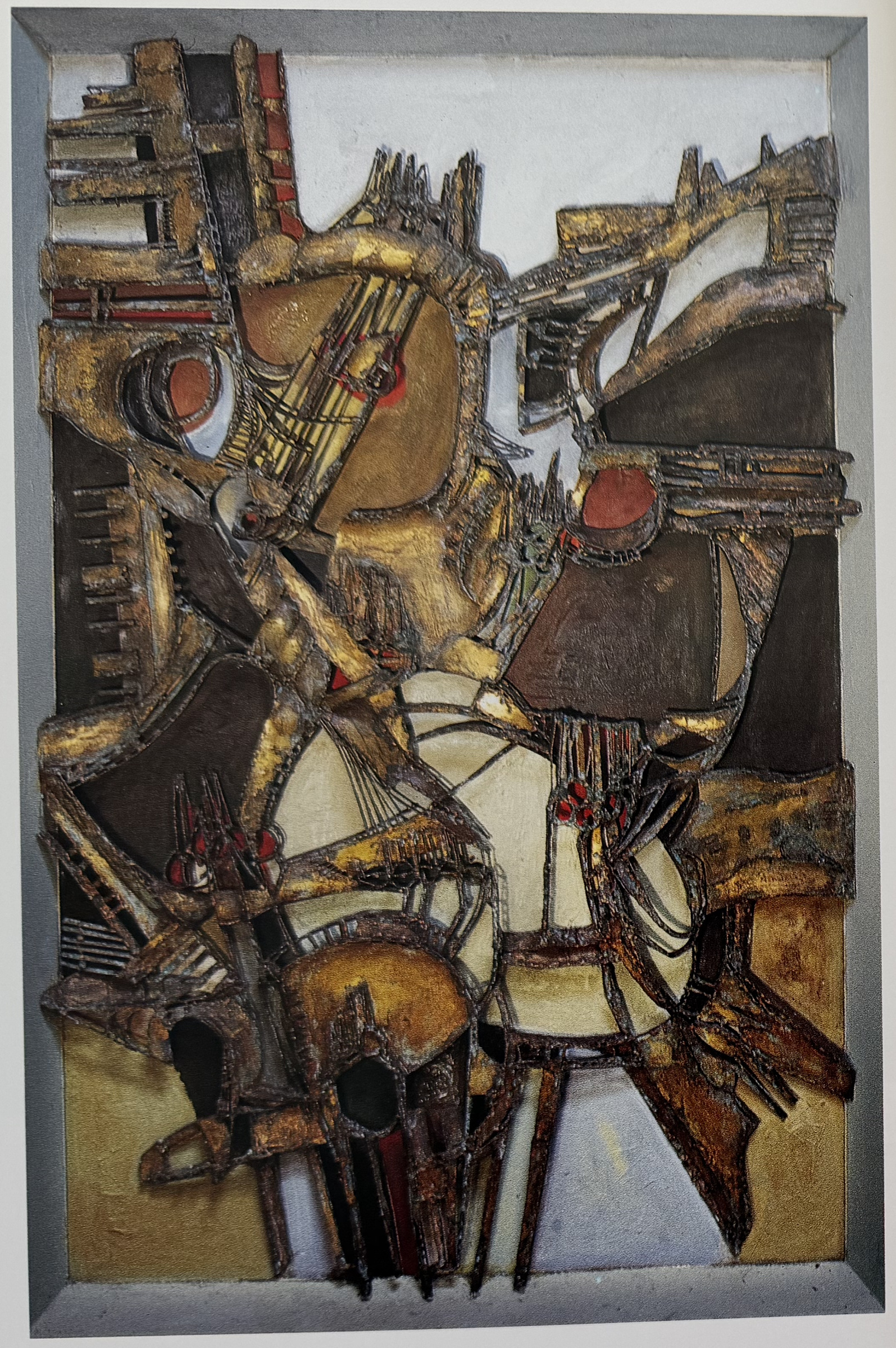
The musical title invites attention to these repetitions and variations. Here, the suggestion of movement develops across the surface through changes in direction, spacing, and colour.
For related discussions, see Drawing in space and Where sculpture meets colour.
Sources
1. Sapfo A. Mortaki, Η καλλιτεχνική μετανάστευση στην Ελλάδα: από τον 19ο στον 20ό αιώνα (1870–1970): η περίπτωση του Κωνσταντίνου Ανδρέου, doctoral dissertation, Aristotle University of Thessaloniki, 2010, main volume, pp. 315–316.


2. Mortaki, same dissertation, main volume, pp. 316 and 322–323. The comparison of the 1973 spacecraft to a great bird appears on p. 323, n. 305, where Mortaki cites Michèle Dubreucq, Andréou: 40 ans de sculpture (1975), p. 28. Bibliographic record for Dubreucq’s volume.


Artwork titles and dates follow the inspected captions in ANDREOU / ΓΛΥΠΤΙΚΗ / SCULPTURE: BAS-RELIEFS EN COULEURS (Athens: Bastas Editions, 1999), pp. 32, 37, 89, and 26 respectively. The description of the medium as welded brass is based on the volume’s Greek and French technical note. Library record for the volume. Present collection statements follow the linked Archive records; the Hellenic Diaspora Foundation also lists the bird that does not fly in its collection. Descriptions of the four illustrations are the Archive’s observations of the reproductions.